

It’s 5:40 on a Wednesday. The fridge is open, the chicken’s been thawing since Monday, and two kids and a partner have all asked what’s for dinner in the last ten minutes. You don’t have an answer, because you used up the part of your brain that answers that question somewhere around 3 PM.
That’s usually the moment a family meal planning app gets downloaded. Something about the week stopped working, and there are dozens of them promising a calmer one. Most won’t deliver it. Not because they’re badly built, but because nearly all of them are built to solve a problem your household doesn’t actually have.
The recipes were never what you were short on. The deciding was. Cooking the food was rarely the hard part; the hard part is being asked to choose it, again, at the hour you’ve got the least left to give. An app that just hands you more to choose from has only added to the pile you’re already standing under.
Why most family meal planning apps miss the real problem
Open most of them and the pitch is the same. A big library of recipes. A place to save the ones that look good. A calendar to drag them onto. A grocery list that builds itself, once you’ve done all the choosing.
Look a little closer and you’ll see the app handed the real work straight back to you. It found you more recipes. It didn’t decide a single dinner. You’re still the one slotting meals around the Tuesday practice that runs to 7:15, the eight-year-old who decided this month she hates anything with sauce, the ground beef that never made it out of the freezer. That’s the part that wears a household down across a week. It’s also the part most apps quietly leave on your plate.
A family meal planning app that’s really a recipe box with a calendar bolted on hasn’t touched the hard part of the week. It put a search bar on it.
What real families actually need from a family meal planning app
Strip away the screenshots and the feature grids, and one question is left worth asking any family meal planning app. Does it do the deciding, or does it just give you a tidier place to do the deciding yourself?
That single line splits the whole category. On one side, the apps that hand you a recipe box, a meal calendar, a list builder, and then wait for you to run all of it. On the other, the much smaller group that shows up with the week already worked out. Meals chosen. Sized to the people actually at your table. The shopping already falling out of the plan.
A real family doesn’t need more options at 6 PM. It needs fewer decisions. The meal settled before the hungry part of the evening starts. A list that already exists. Food the people in your house will actually eat, instead of an aspirational version of them. A plan that doesn’t come apart the first time Tuesday goes sideways.
Everything else people line up and compare sits downstream of that one split. The recipe count, the photo quality, the seven sorting filters, whether it talks to your watch. A beautiful app that leaves the deciding to you is the one sitting unopened by Friday. The plain one that did the deciding is the one you’ll still have open in March.
Where family meal planning apps usually break down
The pattern runs the same in most houses. Sunday goes well. You sit down with the second coffee and the app, full of Sunday energy, and plot five dinners and a shopping list. Monday holds. Then Tuesday wobbles, and by Wednesday at 6:10, with a kid doing homework at the counter and asking when food, the plan and the week you’re actually having have drifted too far apart to bring back together.
Call it what it actually is: a design problem in a discipline costume. Most family meal planning apps quietly assume the week runs the way you mapped it on Sunday. Real family weeks almost never do. Kids change their minds. Practices run long. The thing you bought to use on Thursday goes off on Tuesday.
The version of you with Sunday’s coffee and the version of you at 6:10 on Wednesday aren’t the same person, and they aren’t working with the same amount left in the tank. A plan that needs Wednesday’s energy to keep itself going was built for a week nobody actually has.
What a family meal planning app looks like when it does the deciding
Here’s the other version of that Wednesday.
You open the app at 5:30 and the night’s dinner is already there, chosen for the four of you, built around the household you actually feed instead of an ideal one. The list to shop from is already sorted by aisle, pulled straight out of the plan instead of stitched together by hand afterward. Nothing asks you to operate it. No searching, sorting, dragging, merging.
The thinking got done earlier, by something that wasn’t running on empty at six with a kid asking when food. If a meal doesn’t fit the night you’re actually having, you change it, and the rest of the week still holds. You’re in charge of every call here. You just don’t have to make all of them from scratch, at the worst hour of the day, ever again.
That’s the shape of an app that went after the right problem for a family, not the easy one.
Why more features make a family meal planning app worse, not better
When dinner feels hard, the instinct is to reach for more. More recipes, more filters, more ways to tag and sort and favorite. The app stores reward it. A longer feature list looks more capable on the page.
But every feature you have to operate is one more decision the app pushed back onto you, and decision fatigue is the whole reason dinner feels heavy by Wednesday in the first place. A library of ten thousand recipes just gives you ten thousand more things to weigh, at the exact hour you’ve got the least left to weigh anything with. The folder of sixty recipes you bookmarked at 11 PM and never once cooked is the proof.
For a family it costs you twice over. You’re not only deciding what you’d like to eat. You’re solving at the same time for the picky one, the partner who skips meat on Mondays, the toddler deep in a beige-food phase, the night three people get home late. The family meal planning app worth keeping does less of that to you, not more.
Where A Better Meal fits
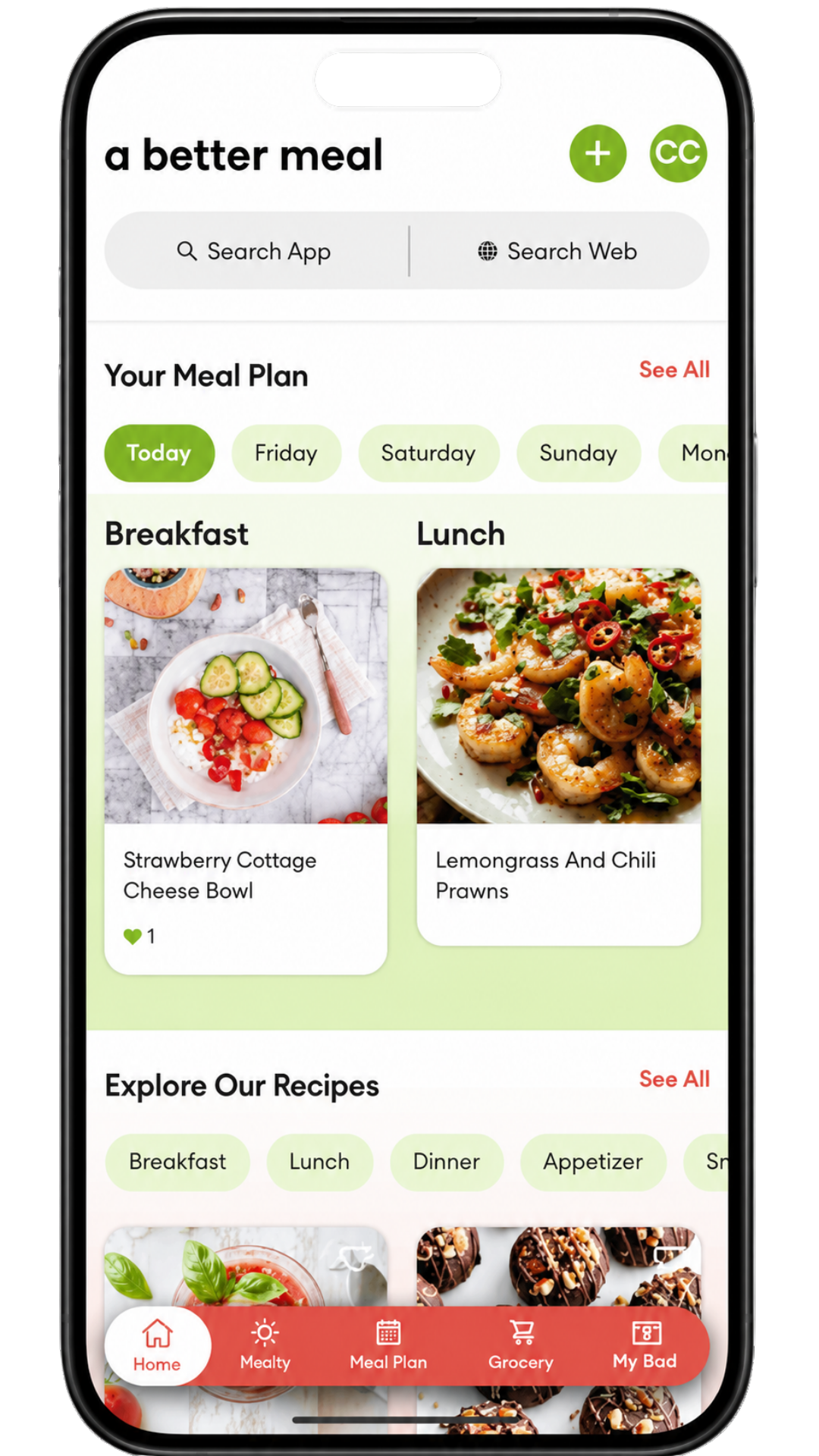
A Better Meal starts from a single idea: the plan is the product. Not a recipe library to dig through on a Sunday night. Not a tool you operate. A plan for your household that’s simply there when you open the app. The thinking was always the hard part of the week, and the plan is the thing that does it for you.
So the deciding that every other family meal planning app leaves on your plate is the part A Better Meal treats as its own job. The plan comes built around the household it has to feed, made for the way your weeks actually run rather than the way they’re supposed to. The grocery list comes straight out of it, sorted by aisle and scaled to the number of people you’re feeding, and it opens in the grocery service you already use, close to 50 of them, so one shop covers the week instead of three half-remembered trips.
And none of it locks you in. The plan is a starting point, not a rulebook. Don’t want Thursday’s dinner? Change it. Houseguests this weekend, or a night nobody’s home until eight? Move things, swap them, or leave the week exactly as it is and just cook. The deciding was handled before you got there, and you’re still the one who can change any of it.
The plan you keep meaning to sit down and make? It’s already in the app. Get your family’s meal plan.