A sheet pan holds an entire dinner and asks nothing of you until it’s done. One vessel, one oven temperature, one trip in and one trip out. That’s most of what people mean by sheet pan dinners, and it has very little to do with the recipe. It’s the number of decisions standing between you and a plate.
Late in the day, when the kitchen is the last room anyone wants to be standing in, that number matters more than flavor. The oven does the browning. There’s no second pot to watch and no sauce that needs stirring while something else finishes, and for that stretch nobody’s circling the kitchen waiting on you to referee three cooking projects at once.
Why sheet pan dinners feel like the answer
The draw isn’t really the food. A stir-fry is just as fast, and a soup barely needs supervision. What a sheet pan dinner removes is the sequencing: no timing four things to land at once, no extra burner to babysit, no second pan waiting in the sink before you’ve even sat down. One tray goes in, one tray comes out, and cleanup is one job, not five.
That’s real relief on a night with nothing left in the tank. It’s also, on its own, a smaller fix than it looks like. A sheet pan dinner still has to get chosen. Someone decides what goes on the tray, whether there’s a vegetable that survives the oven at the same temperature as the protein, whether tonight is a chicken night or a sausage night. The tray solves cooking. Deciding is a separate job, and it happens earlier.
Versatility gets a lot of the credit for sheet pan dinners’ popularity, and it’s earned. Almost any protein pairs with almost any vegetable at 400 degrees, which is exactly why the format feels endlessly flexible, and also why it quietly hands the decision back to you every single time. Flexible isn’t the same as decided. A tray that can hold anything still needs someone to pick what it’s holding tonight. Chicken or sausage, potatoes or rice: five minutes of standing at the fridge doing math that has nothing to do with the oven.
Fifteen sheet pan dinners you didn’t have to invent are below. Most nights, one of them is exactly what you needed. It’s also, still, a list, and A Better Meal exists because a list is only half of what runs out on you by midweek. The tray handles tonight. Something else has to handle the fact that every night after it needs its own answer too.
Sheet pan dinners, grouped by what the night actually needs
Here’s a starting list, grouped by the actual constraint, not by cuisine. Find the line that matches tonight, take the first thing that fits, and stop looking. If tonight’s problem is bigger than which tray to use, the wider list of quick weeknight dinners covers the nights a sheet pan doesn’t fit.
When you’ve got about twenty minutes and a busy stove is the last thing you want
- Kielbasa, bell peppers, and red onion, cut small so everything finishes together
- Shrimp with cherry tomatoes and a squeeze of lemon at the end
- Salmon with asparagus, usually done before the oven’s even fully preheated
- Cheese tortellini tossed raw on the tray with olive oil and cherry tomatoes
When someone at the table inspects every plate before agreeing to eat
- Chicken thighs with plain roasted potatoes, kept in their own zones
- Meatballs and broccoli, nothing touching
- Turkey sausage with sweet potato wedges, sauce on the side
When you want it to feel like more than “the vegetables you had”
- Sausage, red peppers, and fingerling potatoes with a hot honey drizzle
- Chicken thighs with lemon, olives, and small potatoes
- Roasted root vegetables with a fried egg on top
- Salmon with a soy-ginger glaze and broccolini
When it’s feeding more people than usual
- Two trays of the same chicken-and-potato combination, staggered on separate racks
- A big batch of sausage and peppers that reheats fine for lunch the next day
When cleanup is the actual dealbreaker
- Foil-lined trays with sausage, potatoes, and green beans, so the pan itself never needs scrubbing
- Chicken drumsticks and carrots, one sheet, one rinse
- Tofu and broccoli with a sheet of parchment doing the dirty work
None of these need a recipe you have to go hunt down first. Swap the vegetable, swap the protein, keep the general ratio close to what’s listed, and the tray still works. If you’d rather start from something already tested than build one from a bullet, this roundup of sheet pan dinners has three full recipes written up already, not just an idea and a hope.
A tray fixes tonight. The choosing comes back tomorrow.
A sheet pan dinner is a genuinely good answer to today. It’s a worse plan for the whole week, because the tray doesn’t remember what you cooked twice already and doesn’t notice you’ve reached for sausage four nights running. Somebody still has to look at the week and decide when the tray shows up and when it doesn’t.
Sausage and peppers again Tuesday, sausage and peppers again Friday, and nobody planned that on purpose. It just kept being the easiest yes, until it stopped feeling like a choice and started feeling like the only option left.
There’s also the fridge problem the tray never touches. A sheet pan dinner doesn’t know that Tuesday’s chicken is still sitting there because Monday turned into takeout, or that half a bag of green beans has been going soft in the crisper for four days. It just waits to be filled with whatever gets put on it, which is exactly why the same three combinations keep winning. They’re not the best options. They’re the ones you can name without thinking.
None of that is a personal failing. A rotation is what happens when choosing gets outsourced to whichever three dinners are easiest to picture under pressure, night after night, until they stop looking like choices and start looking like the menu. Laziness has very little to do with it.
That’s the part a good format can’t do by itself. A method solves cooking. It was never going to solve the deciding that happens before cooking starts, standing at the fridge working out what tonight even is.


A tray you can trust on the night you’ve got nothing left
The relief of a sheet pan dinner is that it isn’t a gamble. You know the shape of it before you start: protein, something roasted, twenty-five minutes, done. On a night that’s already gone sideways, a familiar shape is worth more than a clever one.
A plan works the same way, just further upstream. A plan you can trust on a night like this doesn’t ask you to be creative at 6:15 with a kid parked on a stool asking how much longer. It already decided, back when you had the attention to spare for deciding, not now, with nothing left.
By the time dinner actually needs to happen, the deciding is done, and what’s left is genuinely just the tray.
That’s what a plan you can trust actually buys you: a grocery list you don’t have to double-check, because what’s on it already matches what the week needs, and meals your family will actually eat, because the plan was built around what you told it, not a guess. Reliability isn’t flashy. On the exact night you have nothing left, it’s the only thing that matters.
What A Better Meal actually does
A Better Meal starts from the same idea as the tray: fewer decisions between you and dinner, not more recipes to sort through.
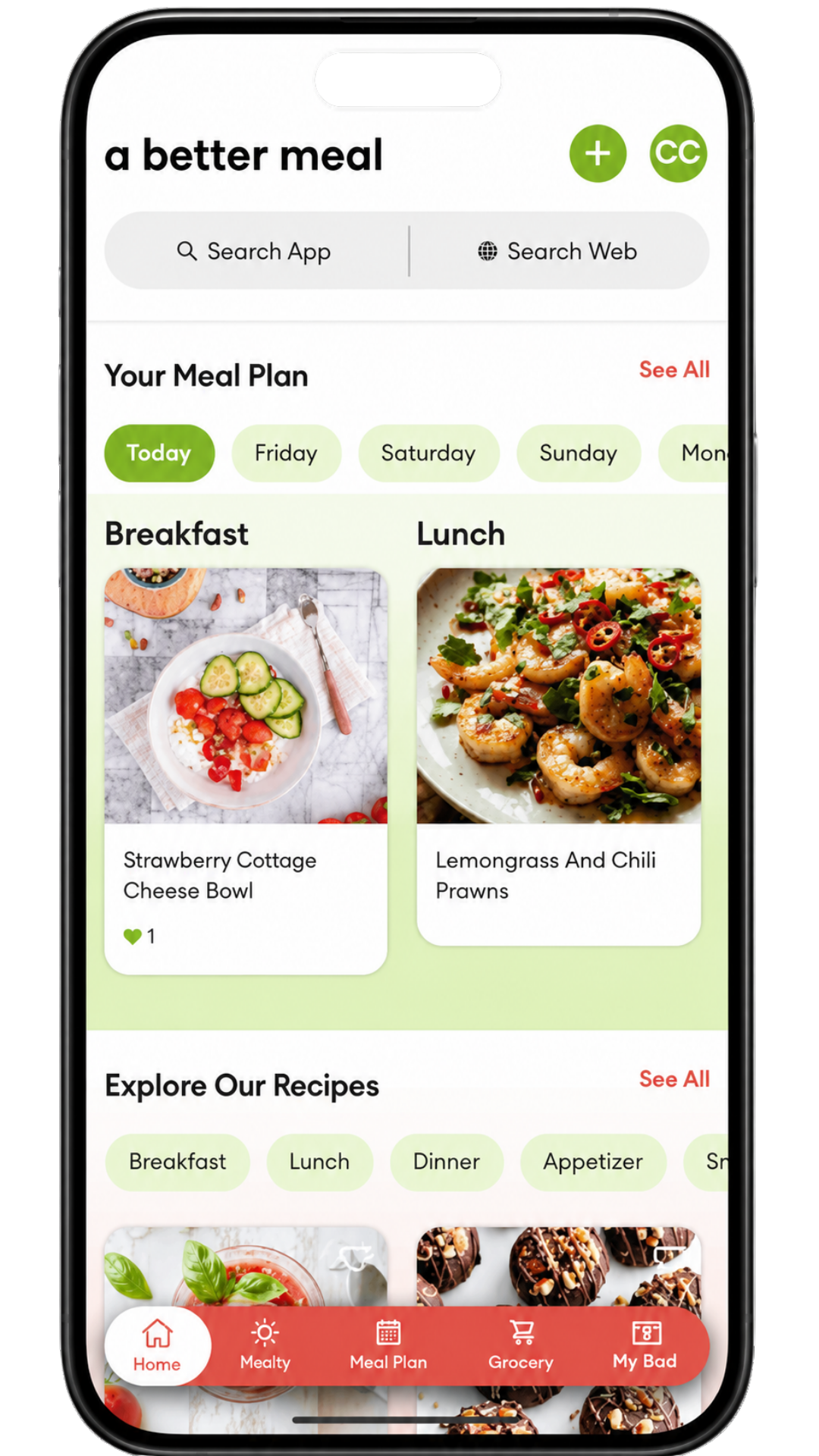
You tell it your goals, dietary preferences, allergies, foods to avoid, and what looks good. From that, A Better Meal builds a dinner plan instead of asking you to start from a blank page. If a sheet pan dinner already earns a regular spot in your week, bring it in. Recipe import means the one you already trust lives alongside everything else the plan builds, so “the good tray recipe” doesn’t only exist in a screenshot you can never find again.
Some weeks the plan lands a dinner that’s more than you have left to give it. That’s what plan actions are for: you can reduce the time it takes, simplify the instructions, or ask for fewer ingredients, and get back to something closer to tray-simple without deciding anything new. None of that is the app deciding for you, either. You’re the one who taps “fewer ingredients” when tonight calls for it. The plan just makes sure that lever is there instead of you having to invent a simpler dinner from scratch at the worst possible hour.
None of that requires you to track what’s repeating too often, or decide, fresh and exhausted, what tonight’s format should be. The grocery list for the week comes out of the plan already built, sorted by aisle, so what the tray needs is on it before you’re standing in aisle six patting your pockets for a list you forgot to bring.
Sheet pan dinner questions
What’s the right oven temperature for sheet pan dinners? Most work well at 400–425°F. Higher heat gives vegetables better color and a crisp edge, but it also means checking that everything on the tray finishes at close to the same rate. Dense root vegetables usually need a head start on something like shrimp or thin chicken cutlets.
Is it safe to cook chicken and vegetables on the same tray? Yes, as long as everything reaches a safe internal temperature. Poultry needs to hit 165°F at the thickest part, and it’s worth keeping raw chicken from touching anything that won’t go back in the oven. The USDA’s minimum internal temperature chart is the reliable reference if sheet pan chicken dinners are going into regular rotation, and the USDA’s guidance on separating raw meat from other foods covers the cross-contamination basics worth knowing before that first tray goes in.
Do sheet pan dinners work for picky eaters? Often better than other formats, because nothing has to touch. Keep proteins and vegetables in their own zones and a picky eater can eat around what they don’t want without the plate becoming a negotiation. It’s the same logic behind why family-approved meals beat perfect meal plans: food that actually gets eaten beats food that’s technically well-planned.
Can sheet pan dinners work for a bigger family? Up to a point. A standard half-sheet pan holds enough for four to six servings depending on what’s on it. Past that, it’s two trays on two racks, swapped halfway through so both sides brown.
Do I need to line the pan? You don’t, but cleanup gets harder and delicate proteins like fish are more likely to stick without it. A layer of foil or parchment costs nothing and keeps the tray as the only dish you’re washing, which is most of the point to begin with.
Are sheet pan dinners actually healthy? That depends entirely on what’s on the tray, the same as any other format. Roasting doesn’t require the oil a sauté does, and a tray built around a lean protein and two vegetables lands pretty differently than one built around sausage and potatoes most nights. The format doesn’t decide that. What goes on it does.
A sheet pan gets you out of the kitchen twenty minutes sooner. A plan gets you out of the deciding altogether, and that was the part actually costing you the most. Some nights all you need is the tray. The other nights, when even the tray feels like one decision too many, the plan is the thing that was already handled. Either way, dinner stops being a question you have to answer twice.
Open the app. The plan’s already there.