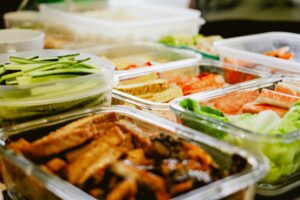

Dinner often leaves useful ingredients for the next day’s lunch: extra rice, half a bag of peppers, roasted vegetables, or another serving of chicken. Using what is already in the fridge makes lunch easier to put together.
People searching for healthy lunch ideas rarely need hundreds of new recipes. They need practical options that fit the food they already have and the time available. A weekly dinner plan helps because some of tomorrow’s lunch has often been prepared the night before.
A Better Meal doesn’t plan lunch, and this piece isn’t going to pretend it quietly does. What it plans is dinner. Decided once for the week, that dinner plan generates exactly the kind of leftover ingredient, extra portion, and half-used container that lunch needs and almost never gets asked to plan for on its own.
Why the dinner decision keeps paying for lunch too
Almost nothing gets cooked in the exact quantity one meal needs. Recipes are written to feed four when the household has three. A bag of rice cooks better in a batch than in a single cup. A bunch of anything from the produce aisle rarely divides evenly into one dinner’s worth. The overshoot gets treated as a rounding error, something to shrug at or toss, when it’s actually the raw material for the next day’s lunch, sitting there before anyone asked for it.
Brown rice gets cooked in batches too big for one dinner more often than anyone plans for. A half-cup survives most weeks, quietly, and it’s already seasoned by the time lunch needs it. Nobody scheduled that half-cup. It just happened, because a pot doesn’t measure itself down to the exact serving count of one meal on one night.
None of this is specific to any one ingredient. Whatever dinner is built around that week, some protein, some grain, some vegetable, tends to leave a little more than one meal used up. The pattern holds whether dinner was a roast chicken, a pot of chili, or a tray of roasted vegetables. The specific leftover changes from week to week. The fact that there’s one, most weeks, doesn’t.
This is the part a search for healthy lunch ideas skips over. The question people are actually asking, most of the time, isn’t “what should I make for lunch.” It’s closer to “what do I already have that I haven’t recognized as lunch yet.” Those are different questions, and only one of them requires a new decision.
What “healthy lunch ideas” is actually asking for
“Healthy” carries a narrower, more specific meaning than the word gets credit for on a label or a search results page. The FDA’s rule on the term “healthy” sets real limits on saturated fat, sodium, and added sugar, and requires an actual contribution of protein, fiber, fruit, or vegetables before a product can use the word at all. Strip the marketing language back and the bar is plain: some protein, some fiber or a whole food, without sugar and sodium loaded in to make up for flavor lost elsewhere.
Measured against that plain bar, a lot of what already ends up in a dinner-adjacent fridge clears it without anyone trying. A can of tuna bought for one dinner salad doesn’t get bought again the next day. It goes into a lunch container instead, while the rest of the morning is already moving. Nobody built that lunch around a nutrition target. It just happens to hit one, because the ingredient it’s built from was chosen for dinner with the same bar in mind.
The search for healthy lunch ideas assumes the healthy part is the hard part. Usually it isn’t. The hard part is remembering that the ingredient already qualifies, sitting in a container, before anyone reaches for a new recipe to solve a problem that’s mostly already solved.
The reflex to find something new, and what it misses
Once the same lunch shows up three days running, the instinct is to go looking for something different. That’s a reasonable reflex on its own, but it usually solves the wrong problem. The thing that actually needs fixing is a failure to notice what already showed up from somewhere else, not a shortage of ideas.
Bell peppers bought for a stir-fry that only used half the bag go soft in the crisper if nobody finds a second use for them. At 7 AM, half a bag of peppers from Tuesday’s dinner is exactly what turns a plain sandwich or a grain bowl into something worth packing. Left alone, that same half-bag becomes what the EPA’s own guidance on preventing wasted food at home describes: food bought with intention, used partway, then quietly thrown out because nobody circled back to it before it went bad.
A rotation of three or four lunches built from whatever dinner already generated beats a wider search for fifteen new ideas that never get repeated long enough to become a habit. Three or four, repeated, is the version of healthy lunch ideas that actually survives a Tuesday, one that doesn’t ask the household to solve the same problem from zero every single day.
Lunch travels. Dinner doesn’t have to.
A meal eaten at a desk, in a car, or standing at a counter between meetings runs on different rules than one eaten at a table with someone else in the kitchen. It’s often cold or reheated by the time it’s actually eaten, hours after it left the fridge. USDA guidance on handling leftovers safely covers exactly that gap, the stretch between a container leaving the fridge in the morning and getting opened again at midday, and it’s part of why the lunches that hold up best travel well cold or reheat cleanly, rather than depending on staying at a precise temperature for six hours on faith.
A tub of hummus bought for one dinner recipe still has a second job waiting for it the next day: a lunch container, five minutes, nothing invented. There’s no recipe involved, just noticing that the thing already sitting in the fridge door was never used up the first time around, and it doesn’t need a new decision to become useful twice.
Most advice aimed at healthy lunch ideas treats the meal like a smaller version of dinner: pick a protein, add a side, done. Lunch runs on somebody else’s schedule, in somebody else’s chair, often eaten in fifteen minutes between two other things. Smaller was never quite the right word for what makes it different.
If the question is specifically about a kid’s lunch rather than the whole household’s, Kids Lunch Ideas the Lunchbox Comes Home Empty From covers that version in more depth, since a kid’s lunch runs on proof and rotation in a way an adult’s doesn’t always need to. This piece is about the spillover that covers the whole table, kids included, without needing a separate system for either.
Dinner, handled
Generate your first plan in under two minutes


7-day free trial, then $6.99/month
or regular price $83.88 $39.99/year SAVE 50%+
Dinner, handled
Generate your first plan in under two minutes
7-day free trial, then $6.99/month
or regular price $83.88 $39.99/year SAVE 50%+
What A Better Meal actually covers, and what it doesn’t
You tell it your goals, dietary preferences, allergies, foods to avoid, and what looks good. From that, A Better Meal builds a dinner plan instead of asking anyone to start from a blank page every week. Most of a household’s food decisions get made right there, once, instead of getting remade every night at six. The grocery list gets created from that plan in one action, sorted by aisle, and the edits don’t touch the plan underneath, so whatever gets bought for that week’s dinners is bought once, in one trip, not assembled meal by meal as the week goes.
That’s most of what makes the lunch spillover work in the first place. A decided dinner plan doesn’t just answer what’s for dinner. It quietly stocks the fridge with exactly the kind of leftover portion, half-used bag, and extra container that a healthy lunch needs, without anyone having to ask for it as a separate feature, because it was never a separate decision to begin with. Nothing about it is new tracking or a second plan — it’s the same one, already running, doing a little more than it gets credit for.
The same logic is why meal prep ideas that hold up and this piece keep landing on the same point from different angles: a decided week produces usable extras almost as a side effect. Why weekly meal planning feels exhausting for busy people is the reason that side effect matters as much as it does. A household running on decision fatigue doesn’t have the appetite left over for a second, separate lunch-planning project, and it shouldn’t need one.
The spillover is the plan, not a new one
A household doesn’t need a second planning system to get healthy lunch ideas. It needs to notice that the first one, built for dinner, was already doing most of the work. The rice that survives, the peppers that only lost half the bag, the tuna that didn’t get finished — none of it was earmarked for lunch on purpose. It’s just what’s left over when a decision gets made once for the week instead of getting remade every single day, twice. That’s the same idea behind why family-approved meals beat perfect meal plans: the plan that actually holds up is the one built around what the household will really use, leftovers included, not the one that looks best on paper.
A Better Meal is the plan, decided once for dinner. Lunch just gets to ride along. See a week of it ?
Healthy lunch ideas, answered
What are healthy lunch ideas that use dinner leftovers? Anything dinner already generated more of than one meal needed: extra rice, a half-used can, vegetables that only lost half the bag to a recipe. The ingredient already qualifies as healthy; it just needs a container instead of a new decision.
How do I make a work lunch healthier without cooking twice? Usually by not cooking twice at all. The ingredient that showed up for dinner the night before travels fine as lunch the next day, cold or reheated, without a second recipe attached to it.
Does A Better Meal plan lunch the way it plans dinner? No. A Better Meal plans dinner. This piece exists because lunch is the meal that rides on that plan without ever being asked about directly, and it deserved a straight answer instead of a workaround dressed up as a feature.
What’s a quick healthy lunch idea for one person? Whatever’s already in a container from the night before. A portion of tuna, a spoonful of rice, peppers that only lost half the bag, assembled cold or reheated, in whatever holds without going soggy by midday.
How many healthy lunch ideas does a household actually need in rotation? Fewer than most lists suggest. Three or four, built from whatever dinner is already generating that week, cover most households without anyone needing to invent a new one from scratch each day.
Do lunch ideas need to be different for adults than for kids? Mostly in what survives the trip, not in what counts as healthy. An adult’s lunch travels to a desk or a car; a kid’s travels to a cafeteria with less time and more social pressure attached. The ingredient bar is close to the same either way. What changes is portion size, packaging, and how forgiving the setting is if the food comes back untouched.
The lunch question was never really a shortage of ideas. It was a failure to notice that dinner’s decision had already answered it, one container at a time, before lunch was ever asked about directly.