

Flavorish can turn ingredients or a prompt into a recipe for tonight. That is useful when you have food on hand and need an idea quickly.
A Better Meal focuses on a different part of the job: deciding the household’s dinners for the week. The difference comes down to timing. One tool helps answer tonight’s question, while the other prepares the week before that question comes up.
Why the Flavorish app and a decided week keep getting compared
Both promise to end the same moment: standing in front of an open fridge with nothing settled. Type something in, get dinner. On the shelf, they look like they’re solving one problem, and nobody’s inventing that overlap on purpose.
They aren’t the same problem. The Flavorish app and a plan-first app are answering two different questions, even though both will hand you something called a recipe. What could I make with this has an answer in seconds. What is this household eating this week, and is it already decided is a longer question, and it’s the one that actually wears people down.
Type “flavorish app” into a search bar and most of what comes back is some version of the same confusion: is this a recipe tool or a planning tool, and does it matter which one you actually needed tonight. It matters more than either app’s marketing would have you believe.
The person typing it in is usually one of two people, and the split matters more than either landing page lets on. One is looking for something new to cook, which is a genuinely different problem from getting dinner on the table. The other has an actual appointment with 6 PM and just wants the deciding to already be over by the time it arrives.
What an AI recipe generator is actually built to do
Type in what’s on hand, or type in a craving, and an AI recipe tool turns that into a recipe: ingredients, steps, ready by the time you’ve read it. One query in, one recipe out, generated fresh every time you ask. That’s the mechanism behind the Flavorish app, and most of the category it sits in works the same way.
That’s a real convenience for a specific, narrow problem: three ingredients and no idea, on a night with no bandwidth to think about it further. The recipe usually reads fine. Ask the Flavorish app for shrimp and it hands back something plausible, with a method and a cook time and a photo that looks better than your kitchen ever will at 6 PM.
The concept has a name. The Flavorish app is one entry in a wider AI meal-plan category, and most of that category works the same way: single query, single answer, no memory of the query before it. Ask again tomorrow and it has no idea it already answered a version of the same question yesterday.
That’s not a criticism of what the Flavorish app is trying to do. A tool built to answer what can I cook with this is a genuinely different tool than one built to answer what is this household eating this week, and most of the disappointment in this comparison traces back to expecting the first tool to do the second job.
There’s a real appeal in that unpredictability, too. A recipe generator can surprise you, turn three sad vegetables into something worth photographing, suggest a combination you’d never have thought to search for. That’s discovery, and discovery is genuinely fun on a Sunday morning with nowhere to be and nobody hungry yet. It’s a much harder ask on a Tuesday, when what the kitchen actually needs is certainty, not inspiration.
Where the recipe stops and the deciding starts
A recipe answers tonight. It has nothing to say about Thursday.
Ask again tomorrow and the tool starts from zero. No sense of what got cooked two days ago, nothing about what’s already sitting in the crisper going soft, no idea whether the answer it gave last time actually got eaten or quietly abandoned. Every query is its own island. Run the Flavorish app for seven nights and you get seven separate answers to seven separate questions, none of them aware the other six exist.
Ask it for shrimp on a Tuesday and it hands back a marinade that needs an ingredient you don’t have and forty minutes you don’t have either, and the order goes in to the pizza place that already has your card on file instead.
Even when the recipe itself is good, somebody still has to read it, weigh it against what the household will actually eat, check it against whatever’s already defrosting, and commit. A recipe generator can do the first part of that in three seconds flat. It has no opinion on the other three, and those are the parts that actually cost the time.
That’s not a flaw in the tool, either. A generator that produces one good answer per query was never going to be the same thing as a plan. More options arriving faster isn’t actually the relief a tired household is looking for; a fresh idea every time you ask is still one more decision, just a quicker one to reach.
There’s a slower cost too, and it shows up in the pantry rather than at the stove. The farro you bought because a Flavorish grain bowl looked good on a Tuesday afternoon is still sealed, three weeks later, at the back of the shelf. A bag of something that felt like a good idea in the moment is a common way food ends up wasted rather than eaten, and a generator that hands out a new idea every time has no way of noticing it happened. There are six different asparagus recipes saved from six different searches, and the household has actually cooked exactly one of them.
Multiply that across a whole pantry of good intentions and the math stops being funny. A recipe generator measures success by how many ideas it hands you. A decided week measures success by how many of them actually get eaten, and those were never the same scoreboard. The recipes weren’t bad. A fresh stream of ideas was never actually the thing missing from a kitchen that already had plenty of them.
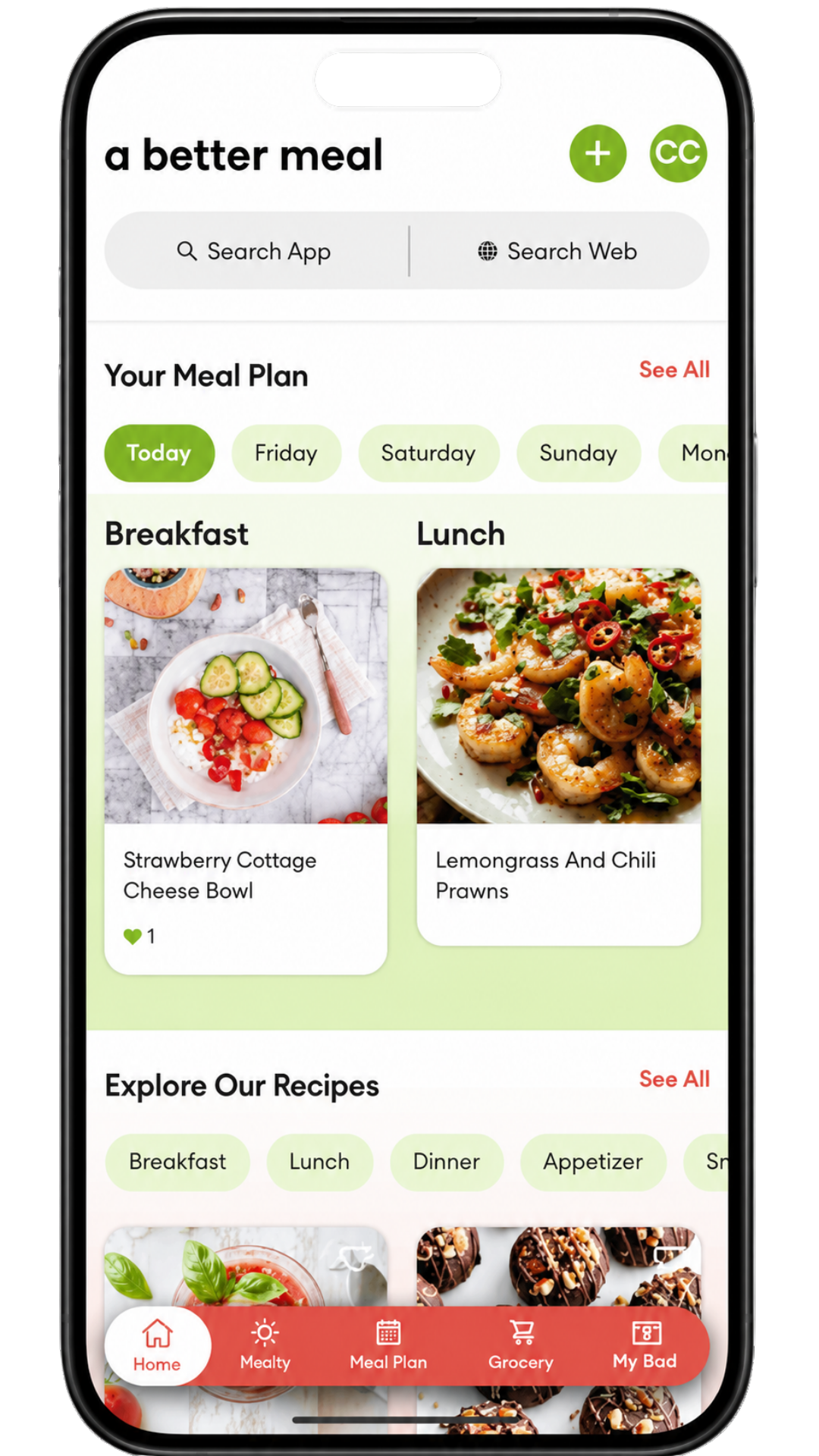
See what your week could look like.
Tap once, get the plan and the list together.
7-day free trial, then $6.99/month
or regular price $83.88 $39.99/year SAVE 50%+
See what your week could look like.
Tap once, get the plan and the list together.
7-day free trial, then $6.99/month
or regular price $83.88 $39.99/year SAVE 50%+
What a decided week does that a recipe generator can’t
The Flavorish app is built to answer one recipe question. A Better Meal is built to answer the standing one: what this household eats this week, decided before anyone has to open an app and ask.
You tell it your goals, your dietary preferences, allergies, foods to avoid, and what looks good. From that, A Better Meal builds a dinner plan instead of asking you to start from a blank page every week, and it can draw from your preferences, saved recipes, and past interactions so the plan isn’t just the same hand-built rotation on repeat. Bring the recipes the household already trusts into the app too, instead of starting over from a stranger’s idea of a Tuesday every time a new query would otherwise have to start from scratch.
The grocery list comes out of that plan in one action, sorted by aisle. Change a line on it and the plan underneath holds. Nobody has to type an ingredient list into anything at 6 PM to get an answer, because the answer for that night was already sitting there since Sunday.
Worth being honest about a limit here too. A Better Meal can’t see your cupboard, and it isn’t trying to. What it does instead is start from what you tell it, once, up front, and keep answering from that instead of asking you to type the same ingredients into a search bar every single night.
It’s 7:05 on a Wednesday, the shrimp has been out on the counter for twenty minutes while you scroll for the specific recipe you saved it for, and somebody’s already asked twice how much longer. That’s the moment a recipe generator gets asked to solve, one query at a time, forever. A decided week skips the scrolling entirely, because Wednesday’s dinner was never a question in the first place.
The honest verdict
Worth being straight about which question you’re actually asking, because both apps will hand you something with the word “recipe” in it and mean something different by it.
Someone cooking for the fun of it, on a night with time to spare and curiosity to spend, gets real value out of a tool that can turn three random ingredients into something unexpected. Someone with a household to feed by a fixed hour, three opinions at the table, and no appetite left for another decision is asking a completely different question, even while typing into the exact same search bar.
If what you want is one good idea for tonight, from whatever’s in the fridge and no time to think past that, the Flavorish app is one reasonable way to answer it. The same gap shows up whenever the tool doing the answering is a general-purpose AI instead of a recipe-specific one, fast, plausible, and only ever answering the query in front of it.
If the actual problem is that the same question shows up every single night and never stops arriving, a tool built to answer one query at a time was never going to close that loop. That’s not a strike against the Flavorish app specifically. A single-recipe generator answering one query at a time is exactly what it was built to be good at, and it’s a fair thing to be good at.
The week that doesn’t need asking again
A Better Meal starts from the household eating dinner this week, not from the ingredient list in front of you tonight. It’s a different starting point, and it produces a different kind of relief: a week that already has its answers filled in before you need them, instead of a fast answer to whichever single question you happened to ask.
A decided week doesn’t need to be asked for twice. It’s still there Wednesday, the same plan you saw on Sunday, unless you’re the one who changed it, and changing it is yours to do, any time, without losing the rest of the week to start over. Here’s what A Better Meal actually does.
The Flavorish app is good at answering the question you put in front of it, right now. A Better Meal is built so the question stops needing to be asked every single night. That’s worth remembering the next time a recipe shows up in seconds and still leaves Thursday completely undecided.
Dinner, handled. Try a week with A Better Meal.
Try the plan-first version.