
An AI meal plan looks fantastic on screen.
Seven dinners. Sensible variety. A tidy little paragraph about balance. All of it in about nine seconds, which is genuinely impressive the first time you watch it happen.
Then Wednesday turns up and somebody has to actually eat the thing.
That’s the awkward part about AI meal plans. The bit they’re best at is also the bit that tells you least about whether your house will eat any differently a month from now.
“AI” is four different things wearing one word
When an app sells you AI meal plans, that could mean any of four things, and they’re nowhere near equivalent.
A language model writing out seven dinner names. A recommender ranking recipes by what people with similar taste have cooked. A generator building a week around rules you typed in. Or a search box with a friendlier tone of voice, which is more common than anybody advertises.
You can tell how loose the word got by the fact that regulators had to go and pin it down. The EU’s AI Act now sorts AI systems into four risk levels, and NIST publishes a whole framework for making AI products trustworthy. Nobody writes documents like that about a word people were already using carefully.
So the question worth asking is narrow. Which of those four are you actually getting, and does any of it stop you having the dinner conversation again next Sunday?
A Better Meal lands on the second half of that. It generates the week, sure. But the point of it is that the deciding is finished by the time you open the app, not that a model was involved somewhere.
The blank page really does go away
Credit where it’s due. Staring at an empty week is hard, and generation kills that stone dead.
It fills the page, which is not nothing when the page has been empty since Sunday. The variety usually improves too, because a model has no habits. It’s never had a Tuesday. It doesn’t remember being wiped out last February and reaching for the same pasta for the fourth week running.
If your house has been cycling the same six dinners for three years, you probably know it, and it probably bugs you a bit. A generator will break that on the first go. That’s real, and it’s most of what “generate a meal plan” should actually get you.
Whether it’s still broken in week three is another matter.
You still have to explain your entire household
Here’s where it gets tiring. The plan takes nine seconds. Telling it enough to be useful takes considerably longer.
Everything your house actually runs on has to get typed in first. The allergy. The thing one person won’t eat and won’t be reasonable about. The two nights nobody’s home. That fennel is a hard no, permanently. What your shop actually stocks, as opposed to what a model somewhere in California assumes is normal.
Miss one and you get a plan that’s confidently wrong, which is honestly worse than a blank page. Now you’re reading seven dinners hunting for the two that won’t fly, at half nine at night, which is roughly when you were hoping to stop thinking.
Then next Sunday you do the whole thing again, because the chat window doesn’t remember your family. That’s most of the gap between a chat-generated plan and one built for a household: who’s holding all that, and whether you have to say it out loud every week.
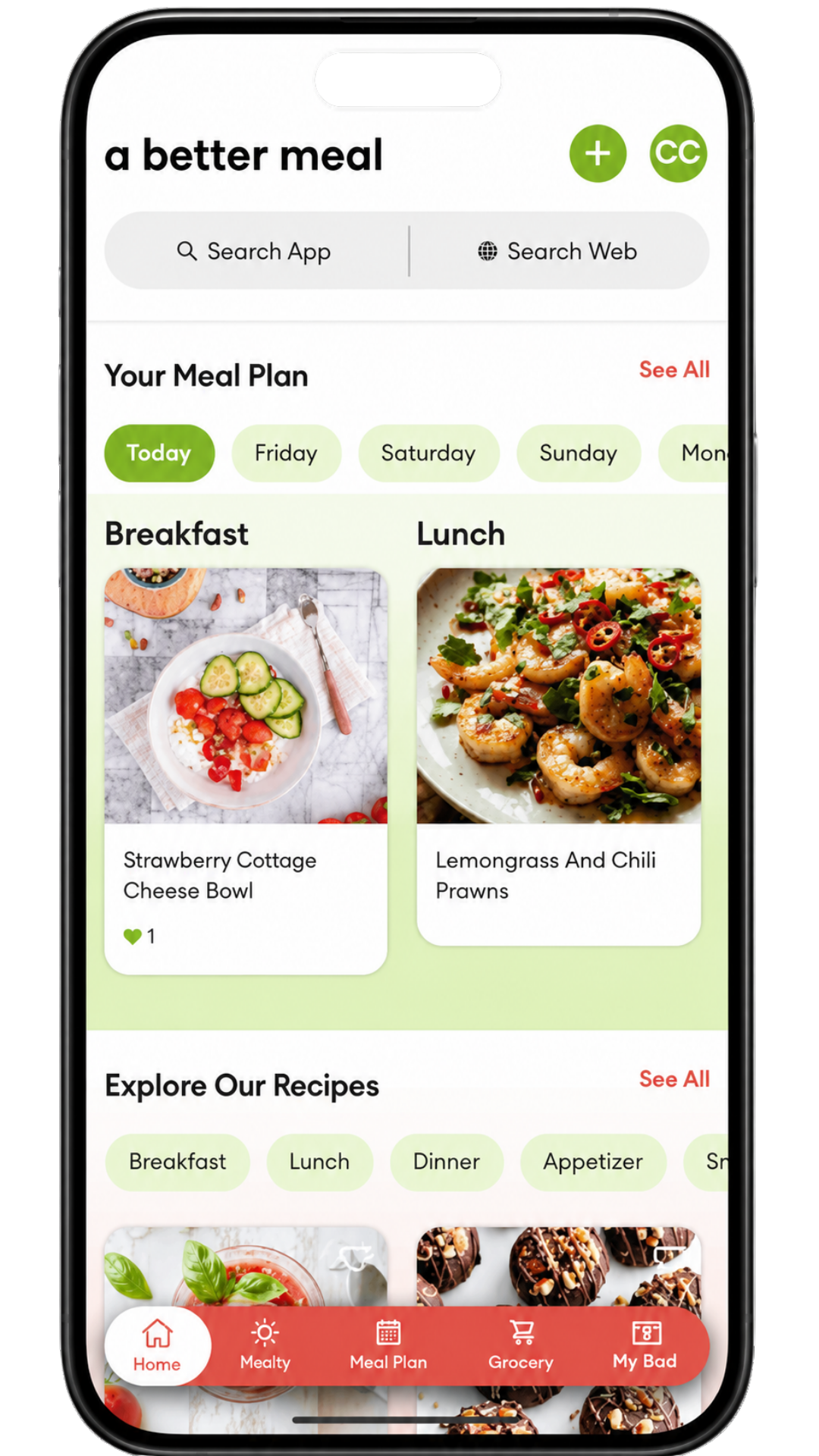
A Better Meal keeps hold of it. You tell it your goals, dietary preferences, allergies, foods to avoid, and what looks good. From that, A Better Meal builds a dinner plan instead of asking you to start from a blank page. You say it once.
So what does the AI in the app actually do
Straight answer.
It runs personalization signals, recommendations and meal-plan generation. The recommender learns from what you do with recipes, and it retrains roughly every twelve hours. It can draw from your preferences, saved recipes, and past interactions so the plan is not just the same hand-built rotation every week.
Now the parts it doesn’t do, which is usually the more useful list.
It doesn’t know what you cooked last week. Nobody should be telling you week two won’t rhyme with week one, because that isn’t a promise this app makes.
It has no idea what your calendar looks like either, so it can’t spot the brutal Tuesday and quietly drop the twenty-minute dinner there. What you can do is ask. Plan actions like reducing time, simplifying instructions, or choosing meals with fewer ingredients are all sitting there. That’s you telling it the week got hard, rather than it guessing.
And there’s no AI grocery list. The list comes off the plan by a plain rule, which is the right call. A shopping list built by inference is a shopping list you’d end up double-checking, and double-checking it puts back the exact job the plan just took off you. Some things ought to be boring.
The stuff it flat out can’t do
It can’t see your cupboard. No pantry, no inventory, nothing quietly subtracting what you already own from what you’re about to buy. Any app promising you that today is showing you a roadmap.
It is not a calorie tracker or macro optimizer. It may show nutrition estimates for recipes, but it does not log your food or build the day around a numeric target.
On money, it doesn’t go hunting for deals. A Better Meal is not a price optimizer, and its budget value is indirect: a settled plan reduces defensive shopping, duplicate purchases, and takeout drift. Slower than a coupon. Sticks around a lot longer.
Those limits are genuinely the useful part of the answer, because an AI recipe generator and a plan are solving different problems, and only one of them shows up on Wednesday.
Thursday is where a plan meets the actual week
It gets to Thursday. Your phone is still very confident about the harissa cod with couscous. There is no cod, because nobody ever turned that lovely document into an actual shop.
That failure has nothing to do with how clever the model is. A plan has to survive a Tuesday, get onto a list, get into a kitchen, and still be standing when the person who made it is running on fumes. Generation handles the first inch of that. Everything after is workflow, and workflow doesn’t demo well, which is why it gets a fraction of the airtime the nine-second trick does.
A Better Meal’s founder puts it like this: “We don’t want to be a tool for doing a task. We are a solution to a problem.” Which reads like a slogan right up until you hold it against this category. Generating a meal plan is a task, and honestly, plenty of things do it well now. Getting dinner settled, every night, for a house full of people with opinions, is a problem. Far fewer things are built to see that through.
So the plan is the product, and the AI is just how it gets made. The week’s decided before you open anything, the list falls out of it, and Thursday already has an answer waiting. You can go and look at how the week gets put together if you’d rather see it than read about it.
Open the app. The plan’s already there.
Try the plan-first version ?