A slow cooker’s whole feature is that it works without you. Turn it on in the morning and it’s still working at six, whether or not you’ve thought about dinner since then. That’s the promise behind every crockpot dinner ideas search: something that keeps cooking so nobody has to keep deciding.
Except deciding is exactly what doesn’t stop. A Better Meal starts from a version of that same problem. The tool was never the gap. The deciding was. It’s worth sitting with why a crockpot alone doesn’t close that gap before getting to a list of what to put in one.
The crockpot goes quiet somewhere around February, back on the third shelf next to a fondue set from the same wedding registry, and it doesn’t come back out until somebody stumbles on a new recipe worth trying in October. That’s not because the food was bad. It’s because a slow cooker only removes one decision out of four, and the other three come back every single week whether the appliance is out on the counter or not.
None of this is really an argument against owning one. A slow cooker is one of the only kitchen tools that actually does what the ads say: leave it alone for eight hours and it turns raw ingredients into dinner, no attention required in between. The frustration people describe when they search for crockpot dinner ideas rarely comes from the appliance falling short. It comes from how quickly its one real skill, unattended cooking, stops mattering the moment nobody’s decided what goes inside it.
The crockpot was never the missing piece
Here’s the actual sequence, every time a slow cooker dinner works. Somebody has to remember the cooker exists that morning. Somebody has to decide what’s going in it. Somebody has to confirm the ingredients are really in the house and not just on last week’s list. And somebody has to start it early enough that dinner’s ready by six, not eight. Four decisions. The appliance only handles the fifth one: the part where a person would otherwise be standing at a stove, stirring something, for two hours instead of ten minutes.
Weekly meal planning is exhausting for exactly this reason, even when every tool in the kitchen is easy to use. Easy isn’t the same as decided. A slow cooker that’s simple to operate still needs a person to choose what goes inside it, and that choice doesn’t get any smaller just because the cooking part got automatic. If anything, an appliance that can technically hold almost anything makes the choosing slightly harder, not easier. A skillet narrows the options by what fits in a skillet. A crockpot barely narrows anything.
That’s why easy crockpot meals keeps getting searched by people who’ve owned a slow cooker for years. The same four recipes go on rotation, more or less permanently, somewhere around spring: the chili, the pulled pork, maybe a roast on a cold weekend. Reaching for a fifth means sitting down and reading through a dozen slow cooker recipes for families after a ten-hour day, which is exactly the kind of task nobody has the appetite for at that hour. So the rotation holds, not out of preference, but because the alternative is homework.
A new recipe doesn’t fix that. It just changes what the decision is about. Fifty more options doesn’t get a Tuesday down to zero choices; it usually adds one, which is which fifty. A household that already owns the appliance, already knows how to use it, and still orders out on a Tuesday has plenty of recipes sitting in a bookmarks folder somewhere. What it doesn’t have is the fifteen seconds of deciding that has to happen before any recipe, good or bad, actually gets used.
That fifteen-second decision has a way of getting more expensive the longer it’s put off. Made early, with the day’s other decisions still ahead instead of behind, it’s nothing: glance at the calendar, pick a dish, done. Made late, with everything else already decided and nothing left in reserve for one more choice, the exact same decision costs ten times the attention for the exact same outcome. A recipe list can’t move when the decision gets made. Only a plan built ahead of the day can do that.
Crockpot dinner ideas that don’t ask anything else of you
Here’s a list that tries to do the opposite of adding options: cut the choosing down instead. Nothing below is sorted by protein, because sorting by protein is exactly the kind of choice that eats the fifteen seconds. It’s sorted by the thing that actually decides whether a slow cooker dinner happens on a Tuesday, which is how much is being asked of the person who has to start it. Find the group that matches tonight, pick the first thing in it, and stop reading. That’s the whole point of a list like this one.
Dump-and-go, no browning step
For the nights when even a skillet is one step too many.
- Pork shoulder with a dry rub, low for eight hours, nothing pre-cooked first.
- White beans with a ham hock and whatever’s left in the vegetable drawer.
- Beef chuck roast with canned chiles, straight from the freezer if that’s still where it lives.
Built to survive the whole week
For a household where cooking twice a week is the actual goal, not a failure to plan more.
- A pot of chili sized for tonight and three lunches after it.
- Chuck roast with carrots and potatoes, cooked in a quantity meant for two nights, not one.
- A red-sauce meatball dish that reheats without turning rubbery by day three.
Mild enough that nobody negotiates
For the household where one person’s idea of flavor is another person’s reason to skip dinner.
- Shredded pork in broth, seasoned after it’s done so everyone can doctor their own bowl.
- A plain pot roast with bread instead of rice, for the one who won’t touch rice on principle.
Comes out of the freezer, not the store
For the week nobody had time for a grocery run.
- Frozen meatballs and a jar of marinara, four hours on low.
- Dried pinto beans, no soaking required if the cooker has the time to spare.
Start whichever one matches the week that’s actually happening, and start it before the morning gets away. No ingredient list to build from scratch. No recipe to compare against three others first. No decision about decision-making. Just the one choice, made once, at the start of the day instead of the end of it.
The list solves tonight. It doesn’t solve six weeks of Tuesdays.
A list like the one above earns its keep for exactly one night. It doesn’t answer the same question next Tuesday, or the Tuesday after that, when the fifteen-second decision comes back around and none of the ten ideas above are top of mind anymore. Quick weeknight dinners run into the same wall: a fast recipe still needs someone to pick it, on the exact night when picking is the expensive part, not the cooking.
The gap isn’t a shortage of crockpot dinner ideas. Nobody genuinely runs out of recipes; there are more slow cooker recipes online than one household could cook through in a decade. What runs out is the fifteen seconds, repeated weekly, that turns a good idea sitting in a bookmark folder into tonight’s actual dinner. A list fixes that gap once. It doesn’t fix the fact that the gap reopens every single week, on a schedule nobody chose.
More options were never going to be the fix, and a bigger list only makes the pattern clearer. Somewhere past the third or fourth crockpot dinner idea, reading the fifth one stops feeling like getting closer to an answer and starts feeling like its own small chore, tacked onto a day that already had enough of those. A list can only reduce the searching. It can’t remove the moment where searching has to happen at all.
What a plan built around a slow cooker actually looks like
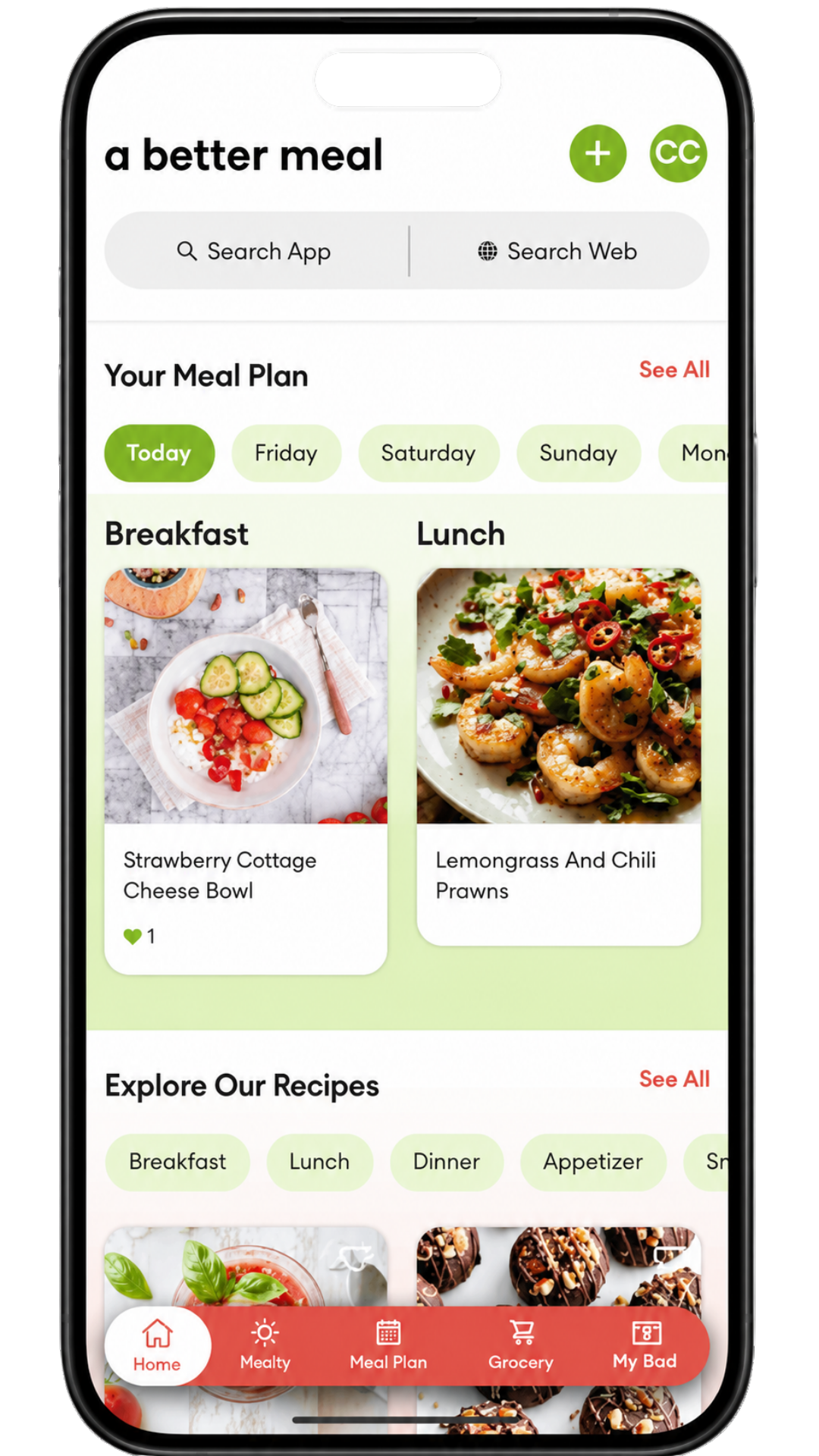
A Better Meal starts from one idea: the plan is the product, not the recipe. A household that leans on a slow cooker three nights a week isn’t a special case the app has to be told about separately. It’s one more thing the week gets built around, the same way the week gets built around a kid who won’t eat rice, or a Wednesday that always runs long, or a partner who’s out of town every other Thursday.
You tell it your goals, dietary preferences, allergies, foods to avoid, and what looks good, and from there the app builds a dinner plan instead of asking anyone to start from a blank page every week. If Tuesday’s the household’s usual set-and-forget night, that’s not a fact anyone has to keep remembering to work around. It sits in the plan the same way Wednesday’s fifteen-minute dinner does, and Thursday’s leftovers do: already decided, already accounted for, not waiting on anyone’s attention.
That’s the real difference between a list and a plan. A list of crockpot dinner ideas gets someone through tonight, and then stops. A plan already knows Tuesday is a slow-cooker night before the week starts, and builds the rest of the week around that fact. The grocery list generates from the plan in one action, sorted by aisle, so the chuck roast and the carrots and everything else for the week show up on the same trip, without anyone standing in the kitchen doing separate math for the slow-cooker night and the rest of the week.
None of this turns the household into a meal-prep operation. Coming home with ground beef meant for tacos, while a browser tab of chuck-roast recipes has sat open on somebody’s phone for three weeks, is the exact situation the plan is built to prevent. Not by remembering for anyone. By having already decided before the grocery trip happened, so there’s nothing left to remember. The plan is a starting point, not a locked schedule; whatever doesn’t fit gets swapped. The deciding is just done before anyone’s standing in the kitchen doing it from scratch, ingredient by ingredient, at the exact moment they have the least patience for it.
It can’t see whether the chuck roast actually made it out of the freezer the night before. That part’s still on the household, the same way it always was. What the plan changes is everything around that one moment: which night needed the roast pulled early, what else the week was counting on, and what fills in if it slips. One thing left to remember beats four.
Food safety still matters as much with a plan as without one. Slow cookers cook safely at a low, steady temperature, but only when the meat goes in already thawed and the dish has enough moisture to it — chili, stew, and pulled pork all clear that bar without effort. For the “built to survive the whole week” group specifically, leftovers hold safely in the refrigerator for a defined window, not indefinitely, and reheating them properly matters just as much as cooking them did the first time. A plan that accounts for a slow-cooker night doesn’t skip that part; it’s built around real food, cooked and reheated the way it actually needs to be.
Stop replanning every Monday. A Better Meal does the plan once, slow-cooker nights included, and the deciding stays done for the rest of the week.