A grocery list has a produce line, a dairy line, a protein line, and a snacks line. Three of those get decided before the cart starts moving. The fourth gets figured out in aisle nine, one bag at a time, based on whatever’s facing out on the shelf. That’s the real story behind most searches for healthy snacks for kids: not a shortage of snack ideas, but a line item that never got a plan in the first place.
Dinner planning has mostly caught up to this. A week gets decided on a Sunday, or close to it, and even when a night gets swapped, there’s still a plan holding the rest of it together. Snacks skipped that whole evolution. They’re still handled the way dinner used to be handled, before anyone wrote anything down: improvised, per day, per kid, per mood, mostly at the store.
Why the snacks line never gets a plan
A household eats one dinner most nights. It eats snacks two, three, sometimes four times a day, spread across a lunchbox, an after-school stretch, and whatever gets handed over in the car on the way to somewhere. Planning four categories of decisions a day is a harder problem than planning one, and nobody’s built the muscle for it the way they have for dinner.
The bag brought home Tuesday for “the kids’ snacks” is a granola bar, a fruit cup, and whatever was priced right near the register, grabbed fast, at checkout, by someone already thinking about the next thing on the list. That’s not a bad decision. It’s the only decision there’s time for when the category never got planned in the first place.
The other reason is that snacks feel small enough to wing. A missed dinner is a crisis. A missed snack is whatever’s closest, chosen for nothing except that it was there. Why weekly meal planning feels exhausting for busy people runs on the same pattern dinner used to, before anyone gave it a plan. Snacks are just further behind. There’s also a store-layout problem stacked on top of the decision problem: the eye-level shelf in aisle nine is stocked by whoever pays for eye-level shelf space, not by whoever’s actually trying to feed a kid well, and grabbing what’s in front of you starts to look a lot like a snack strategy even when nobody chose it as one.
Stack a vending machine or a gas station on top of that and the pattern gets worse, not better. A long car ride or a Saturday tournament turns “whatever’s closest” into whatever’s behind glass and priced for impulse, and there’s no version of a weekly grocery list that reaches into a vending machine. Something decent already in the bag beats hoping the machine has anything worth eating. The machine was never really the problem.
A Better Meal doesn’t try to plan the snacks line either, to be clear. What it already touches is the list that line sits on, and that turns out to matter more than a dedicated snack plan would.
What “healthy” actually means on a snack label
“Healthy” is doing a lot of work on a bag of crackers, and most of that work is marketing, not regulation. The word has a real, narrower legal meaning than the one printed across the front of the bag, and that gap is most of the confusion parents run into at the shelf. The FDA’s rule on the term “healthy” sets specific limits on saturated fat, sodium, and added sugar, and requires a real contribution of food groups like fruit, vegetables, or whole grains before a product can legally use the word at all.
Strip the marketing language back and the bar isn’t complicated: some protein, some fiber, or a whole food, without sugar and sodium loaded in to cover for flavor lost somewhere else in processing. That’s a lower bar than “organic” and a different one than “low-calorie,” which is exactly why two snacks that look nearly identical on a shelf can land on opposite sides of it. “Natural,” for what it’s worth, isn’t a regulated nutrition claim at all. It describes how something was processed, not what’s in it, and a bag can say “natural” and “healthy” without the two words agreeing with each other.
For kids specifically, there’s a second layer most households never see. Schools already operate under federal nutrition standards for snacks sold or served during the school day, because an unplanned snack, multiplied across a week and a classroom, adds up to a meaningful share of what a kid actually eats. A household runs the same math at home without the guidelines attached, which is most of why the snacks line stays messier, longer, than the rest of the list. Healthy snacks for kids get judged by a stricter, more specific bar than an adult’s afternoon snack does, and most packaging doesn’t say so.
The ingredient list is a better guide than the front of the bag most of the time. Added sugar shows up under a dozen different names, cane juice, corn syrup solids, rice syrup, malt extract, and a label can technically be sugar-heavy without the word “sugar” appearing anywhere near the top. That’s not a conspiracy. It’s just easier to read the back of the package once than to trust the front of it every time, and it’s the fastest way to tell two nearly identical granola bars apart.
Healthy and eaten aren’t the same thing for kids
A snack that’s healthy on paper and left in the bottom of a lunchbox didn’t do anything for anyone. This is the part most healthy-snack advice skips, because it’s easier to write about nutrition than about a kid who liked something in March and won’t touch it in April.
A snack that gets left uneaten doesn’t spoil quietly. It comes home in the same lunchbox pocket it left in, wrapper still sealed, the day’s evidence sitting on the counter while the backpack gets unpacked.
Picky eating follows the kid, not the snack. The same resistance that shows up at the dinner table shows up mid-afternoon, just with less negotiating room, because nobody’s sitting across the table watching it happen this time. Meal planning for picky eaters doesn’t mean two dinners covers the dinner-table version of this exact standoff, and the pattern doesn’t change much when the plate becomes a snack bag.
The fix isn’t a better list of “kid-approved” snacks. That list already exists online in a dozen forms, and it’s usually still wrong for a specific kid on a specific day, because a stranger’s ranked list has never met this particular eight-year-old. What actually works is picking from a shorter set of things that have already been eaten before, instead of relitigating the question from scratch every afternoon. Rotation matters more than variety here. A kid who eats the same four snacks all fall isn’t a nutrition problem to solve. That’s four fewer decisions a week than starting over each time.
Two kids in the same house rarely make this simpler. One wants the granola bar, the other decided last month that granola bars are “too crunchy,” and neither opinion is up for debate at 3 p.m. on a school day. A household with more than one kid runs two or three overlapping snack rotations at once, quietly, whether anyone planned it that way or not. Most snack advice is written for a single, generic child who doesn’t actually live in most houses.
4.8 from 2,400 App Store reviews
Trusted by 50,000 families
“Finally an app that actually plans my week instead of just saving recipes. — Sarah, App Store”
4.8 from 2,400 App Store reviews
Trusted by 50,000 families
“Finally an app that actually plans my week instead of just saving recipes. — Sarah, App Store”
What actually holds up in a lunchbox and after school
The healthy snacks for kids that survive a real week share a shape, not a recipe. Something with protein or fiber attached, not sugar alone. Nothing that needs assembly at the exact moment nobody has five spare minutes. And something that’s already gotten a yes at least once, because a first-time snack showing up in a lunchbox is a gamble, and lunch period isn’t the place to run the experiment.
Two kinds of cheese and one kind of cracker account for most of what actually gets eaten after school in a lot of houses. Everything else bought “to round out the snack drawer” gets pushed to the back, still sealed, until it comes out during the next fridge clean-out. That’s not a failure of choosing healthy snacks. It’s what happens when the choosing gets redone from zero every week instead of building on what already worked, the same lesson why family-approved meals beat perfect meal plans makes about dinner.
None of that requires a special aisle or a “healthy kids” section at the store. Most of it is ordinary groceries: fruit that doesn’t need cutting, cheese in individual portions, crackers with something other than sugar as the first ingredient, a handful of nuts where the classroom allows them. USDA’s nutrition.gov keeps a dedicated children’s-nutrition resource page built around this exact question, which says more about how common it is than about any secret snack formula. The category matters more than the brand name on the package, and the fastest way to a decent shelf of snacks is usually the same ten items on repeat, not a wider search for something new.
There’s a waste angle underneath this too, and it’s a real one, even without a dollar figure attached to it. A bag of a “new” snack bought on a whim and rejected once doesn’t usually get a second chance. It sits at the back of the pantry until it’s stale enough to toss, and that’s a small, repeated loss that a shorter, proven rotation mostly avoids. The same ten snacks bought on purpose beat twenty snacks bought on hope, and not because hope is a bad instinct. It just doesn’t survive contact with an actual kid very often.
The same grocery list already has a line for this
Here’s the part that actually changes the snacks line: it doesn’t need its own plan. It needs to stop being a second trip.
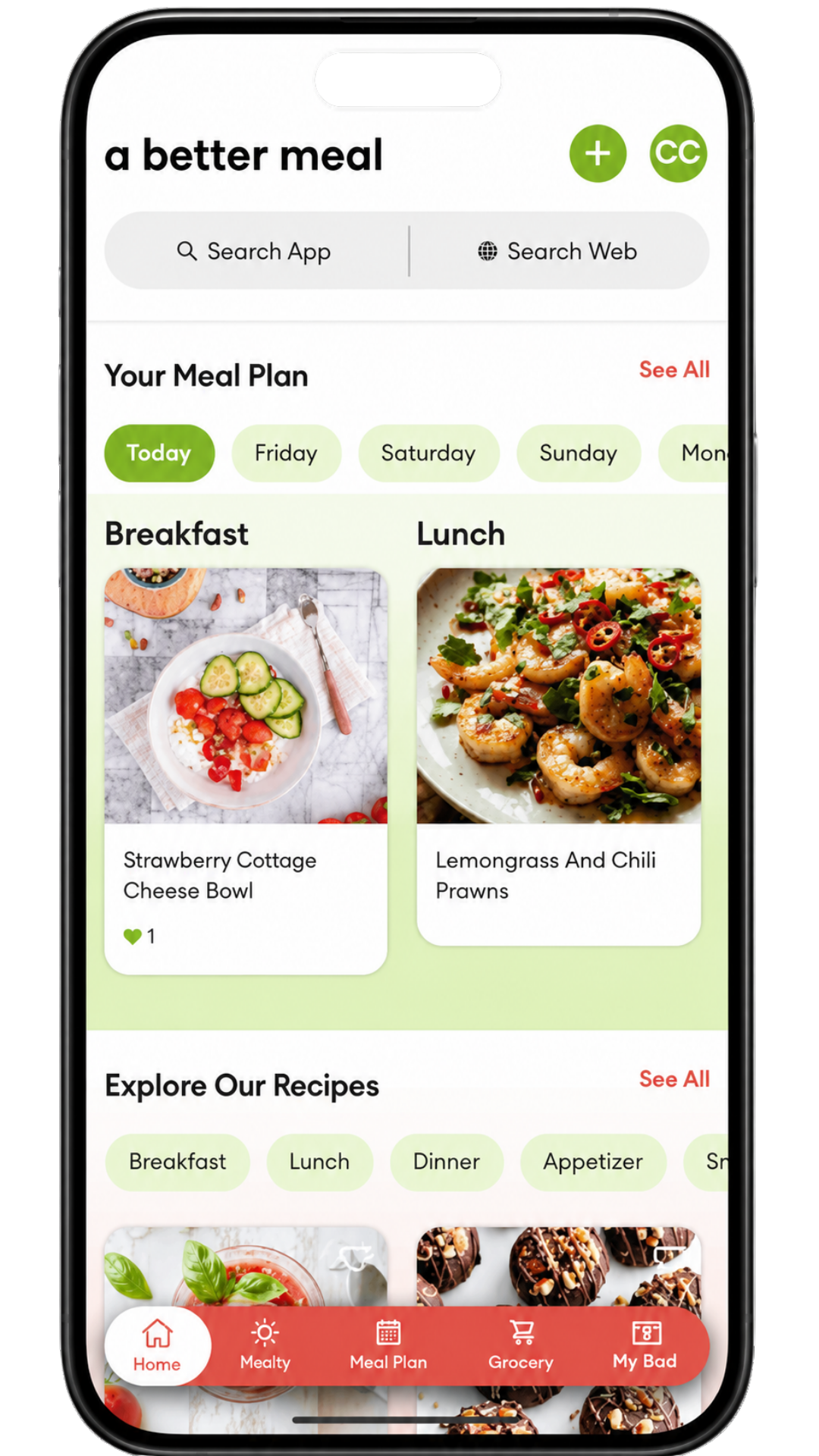
A Better Meal builds a dinner plan, and the grocery list gets created from that plan in one action, sorted by aisle so the trip itself moves fast. It’s not a snack plan and doesn’t pretend to be one. But the list it hands over is editable, and the edits don’t touch the plan underneath, so the snacks line, the paper towels, the school-supply run someone remembered at the last minute, all of it can ride the same list without any of it needing its own decision-making system. A grocery list by aisle fixes the trip. The plan fixes the week covers the mechanics of that same list in more depth.
Onboarding for the dinner plan already asks about allergies and foods to avoid, alongside goals and dietary preferences. That’s the same information that matters for what goes in a lunchbox, and it’s already sitting there before the grocery list ever gets built. None of it turns into a snack plan. It just means the household isn’t re-explaining a nut allergy to two different systems, one for dinner and one for everything else.
The edits stay non-destructive too, which matters more here than it sounds like it should. Adding granola bars and clementines to a list built from Tuesday’s dinner recipes doesn’t touch Tuesday’s dinner at all. The snacks line can change every week, double one week and disappear the next, without anyone needing to rebuild the plan underneath it or start the grocery list over from scratch. That’s a smaller, quieter kind of flexible than “the app adapts to your kid,” and it’s the kind that’s actually true.
One trip covers the produce line, the dairy line, the protein line, and the snacks line, because they’re all on the same piece of paper by the time anyone’s standing in the store. That’s the actual relief, and it’s a smaller promise than “a plan for every snack.” It’s also one that holds up on a Tuesday, which the bigger promise usually doesn’t.
Open the app. The plan’s already there, and the snacks line rides along with it. Get your grocery list, sorted by aisle ?