
You typed “ai recipe generator” into the search bar hoping the technology finally solves the 6 PM question. And it’s genuinely impressive. Tell it what’s in the fridge, and it writes you a recipe in seconds. But a few weeks in, dinner feels about as hard as it did before. The generator’s fast, clever, never tired. It also handed the hardest part of dinner straight back to you, which is the deciding.
What an AI recipe generator actually does
An AI recipe generator takes an input, a few ingredients, a cuisine, a craving, and produces a recipe. Some take a photo of the fridge. Some ask a question or two about diet or time. The output’s a plausible, often good, set of instructions for one meal.
That’s a real capability. For “I’ve got chicken, an onion, and soy sauce, what can I make right now,” it works. As a lookup tool, it beats flipping through a cookbook with floury hands.
The trouble is what it doesn’t touch. It answers “what’s a recipe for these ingredients.” It doesn’t answer “what are we eating this week, and who’s deciding.”
Why an AI recipe generator still leaves you deciding
A recipe generator runs on a prompt. Which means you have to show up, at 6 PM, with the energy to prompt it. Think of the ingredients. Type them in. Read the options. Judge whether tonight’s really the night for the miso thing it invented that needs miso you don’t own.
There’s a catch buried in the word “generator.” It makes more. More recipes, more options, more variations on request. But the dinner problem at 6 PM was never a shortage of options. It’s that you’ve already made a few hundred decisions today, and the part of you that chooses is running on empty. A tool that produces more things to choose from is answering a question you didn’t have, and quietly enlarging the one you do.
So you’re sitting there at 6:10 with ten generated recipes on the screen, regenerating because the first ten didn’t quite land, the kid asking how long, and you’re doing the exact thing you hoped the tool would take off your plate. Deciding. The generator made the recipes faster. It didn’t make the decision for you.
Plan-first meal planning: what changes
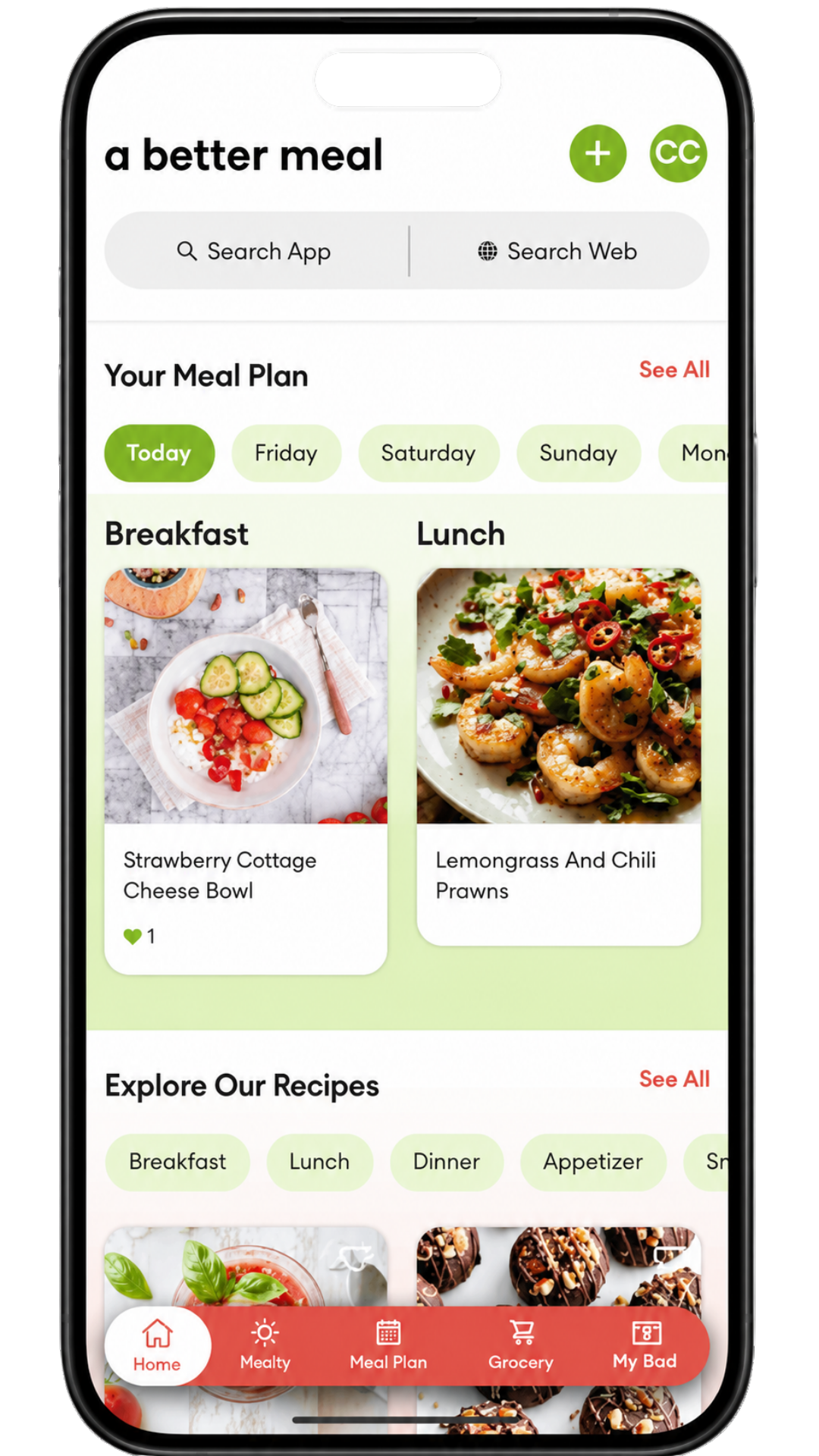
Plan-first meal planning starts from the other end. Instead of generating options at the moment you’re most depleted, the week’s dinners are decided ahead of time, back when you had room to decide, built around the people you actually feed.
The whole difference is where the deciding happens. A generator puts it at 6 PM, on demand, every night. A plan puts it once, up front, and then it’s done. When you walk into the kitchen, the question’s already answered. No prompt to write, no options to weigh, no regenerating. The grocery list comes out of the plan on its own, sorted by aisle and scaled to how many you’re feeding, and it opens in the grocery service you already use, close to 50 of them, so one trip covers the week.
It isn’t rigid. You can look the week over and change what doesn’t fit, or leave it and cook. The plan takes away the obligation to invent dinner from scratch every night, not your say in it.


AI recipe generator vs. a plan, side by side
Put them next to each other and the split is clear.
- An AI recipe generator answers “what can I cook with this?” A plan answers “what are we eating this week?”
- A generator works on demand, which means it works when you’re there to run it. A plan works ahead of time, so it’s already done when you’re not.
- A generator hands you more to choose from. A plan does the choosing.
- A generator treats dinner as a recipe problem. Plan-first treats it as a decision problem, which is the one households actually have.
None of this makes the technology bad. An AI recipe generator is good at what it’s for, and worth keeping around for the nights you want to improvise with what’s on hand. It just wasn’t built for the thing that makes weeknight dinner hard, which is the deciding, not the recipe-writing. A faster way to produce options doesn’t help the person who already has too many and no bandwidth left to pick one.
That’s the line A Better Meal sits on. The plan is the product, not a recipe engine that waits for you to run it. The week’s dinners are decided before you get to the kitchen, so the most depleted version of you, the one standing there at six, has nothing left to solve.
AI recipe generator: quick answers
Is an AI recipe generator good for meal planning? It’s good for the recipe part, not the planning part. It’ll produce a meal for tonight from what you have on hand. It won’t decide the week for you, which is where the actual mental load of meal planning lives. For one-off “what do I do with these ingredients” moments, it helps; for “stop the nightly dinner question,” a plan does more.
What’s the difference between an AI recipe generator and a meal planning app? A generator produces recipes when you ask. A plan-first meal planning app decides the week ahead of time, so you’re not asking at 6 PM. One makes options faster. The other removes the need to choose.
Can an AI recipe generator tell me what to cook with the ingredients I have? Yes, that’s its strongest use, and a fine reason to keep one around for improvising. It still leaves the weekly deciding to you. A plan handles that part up front.
The faster answer isn’t the same as the answered question
An AI recipe generator makes the recipe faster. Dinner was never waiting on a faster recipe. It was waiting on the decision, the one that lands at the worst hour of the day, every night, on the person with the least left to give.
A plan makes that decision once, ahead of time, so the kitchen at 6 PM is just cooking, not choosing.
A Better Meal is the plan. See a week of it.