
The easiest dinner to trust is the one somebody else already cooked.
Not a stranger. A sister, a neighbor, the coworker who brought the same tray to three work potlucks running because people kept asking who made it. Every household keeps a short list like that: meals that didn’t originate at its own stove, that arrived already proven, that nobody ever had to gamble on. A Better Meal is built around the same idea. The plan uses real recipes, not text invented to fill a page, and it’s meant to carry a household’s own proven meals forward instead of asking it to start over every week.
Most meal planning starts from the opposite position: a blank week, a search bar, and a recipe nobody in the house has ever tasted. Every dinner becomes a small bet, made from nothing but a photo and a stranger’s headline.
What actually makes a recipe trustworthy
Recipes earn trust the way most things do: by surviving contact with real people.
Somebody cooked it on an ordinary night, not a styled one. It got eaten, or it didn’t, and that got noticed. It got made again, which is the only vote that counts. By the third or fourth repeat, a recipe stops being an idea and becomes a known quantity — the dish that’s allowed to show up again without anyone objecting.
None of that history shows up on a search results page. A recipe with good photography and a recipe with three years of actual Tuesdays behind it look identical in a list of ten results. A recipe with three years of dinners behind it beats one with better lighting, and the photo can’t tell you which is which.
That kind of proof doesn’t announce itself, either. Nobody writes “tested forty times, two food allergies, zero complaints” under a recipe title. It just quietly becomes the dish a household keeps returning to, the one nobody has to think twice about assigning to a Tuesday. A search engine can’t see any of that. It only sees the recipe as posted, the day it was posted, with no memory of what happened after.
The best version of that proof is oddly specific. Not “good,” but good for this exact group: the picky one, the dairy-free one, the one who decides on a Tuesday that mushrooms are suddenly a problem. A recipe that survives a specific household has earned something a general crowd-pleaser never has to: it’s been tested against people with an actual stake in the outcome, not strangers scrolling past a photo.
What “community” really means for a dinner table
None of this lives in an app feed, a ratings page, or a comments section. It lives at the table it was actually served at: a sister’s kitchen, a work potluck, a folding table at a fundraiser with a recipe stapled inside a mimeographed cookbook. Fundraiser cookbooks compiled by home cooks are a genuine American tradition, stretching back more than a century, built for the specific reason that a recipe worth trusting is one that already worked in somebody’s kitchen.
That’s the original meaning of a community recipe, and it has nothing to do with a platform. It’s a chain of people who cooked the same dish and passed it along because it worked: the recipe card with a coffee ring on it, the dish photographed off a friend’s counter, the one that shows up at every holiday because somebody asked for it twice. Friends and family are still the single largest source of recipe ideas, ahead of any app or algorithm. The habit predates the internet. It just never had anywhere to land inside a meal plan.
It shows up in different forms depending on the household. For some it’s a recipe box passed down at a funeral. For others it’s a group text where someone asks what that pasta thing was, and gets an answer within the hour. For a lot of households right now it’s a saved video on a phone, which works the same way the recipe box always did: point at what already worked, so nobody has to reinvent it.
Why guessing alone wears a household down
Decision fatigue gets described as too many choices, and that’s only half the problem. The harder half is that most of those choices carry no information. A person scrolling recipes at the end of a long day isn’t just picking from a long list. They’re picking blind, because nothing on the page says which option has actually worked before, for anyone.
It’s ten to five and the search bar has three tabs open, all recipes nobody in this house has ever eaten. The lasagna in tab two looks right, gets made, and turns out bland, and by the time anyone admits it, it’s already Wednesday with nothing else planned. Money and half an hour, gone on a guess. Next week the same bet gets placed again, because there was still no way to know beforehand which recipes were worth the risk.
None of that resets when the new week starts, either. The same blind guessing that ate Tuesday’s attention gets asked to happen again Wednesday, Thursday, Friday, each one starting from zero information. A household that’s already tired doesn’t get a discount on the amount of deciding required just because it did the same deciding yesterday.
Weekly planning already runs on a limited budget of attention, and spending part of that budget re-litigating whether a recipe is any good, every single time, is the expensive part. Running low on recipe ideas was never the real shortage. Running low on recipes with a track record was.
What happens to a proven recipe with nowhere to land
Most households have lost more good recipes than they’ve kept. The one a friend read off her phone in a parking lot and nobody wrote down. The recipe torn out of a magazine that got recycled by mistake. The dish somebody’s father made from memory and never once measured, so nobody else ever learned the ratio.
None of that is a failure of taste. It’s a failure of storage. A proven recipe is genuinely valuable and still gets lost constantly, because “remember to write it down” is one more task competing with everything else a household already has running.
Recipe import exists for exactly that gap. The recipes a household already trusts — the ones that already passed the test somewhere — come into the plan instead of staying scattered across screenshots, sticky notes, and someone’s memory of how their aunt made it. What a household already knows doesn’t have to be re-earned from a search bar just because nobody wrote it down in time.
It also settles a smaller worry that keeps people from trying a new planner in the first place. Nobody wants to hand over a working system and get back a stranger’s idea of what the household should be eating instead. Bringing the proven set along means the first week already contains dinners that have been served and approved, not a blank slate dressed up as a fresh start.
What a plan built from proven meals looks like
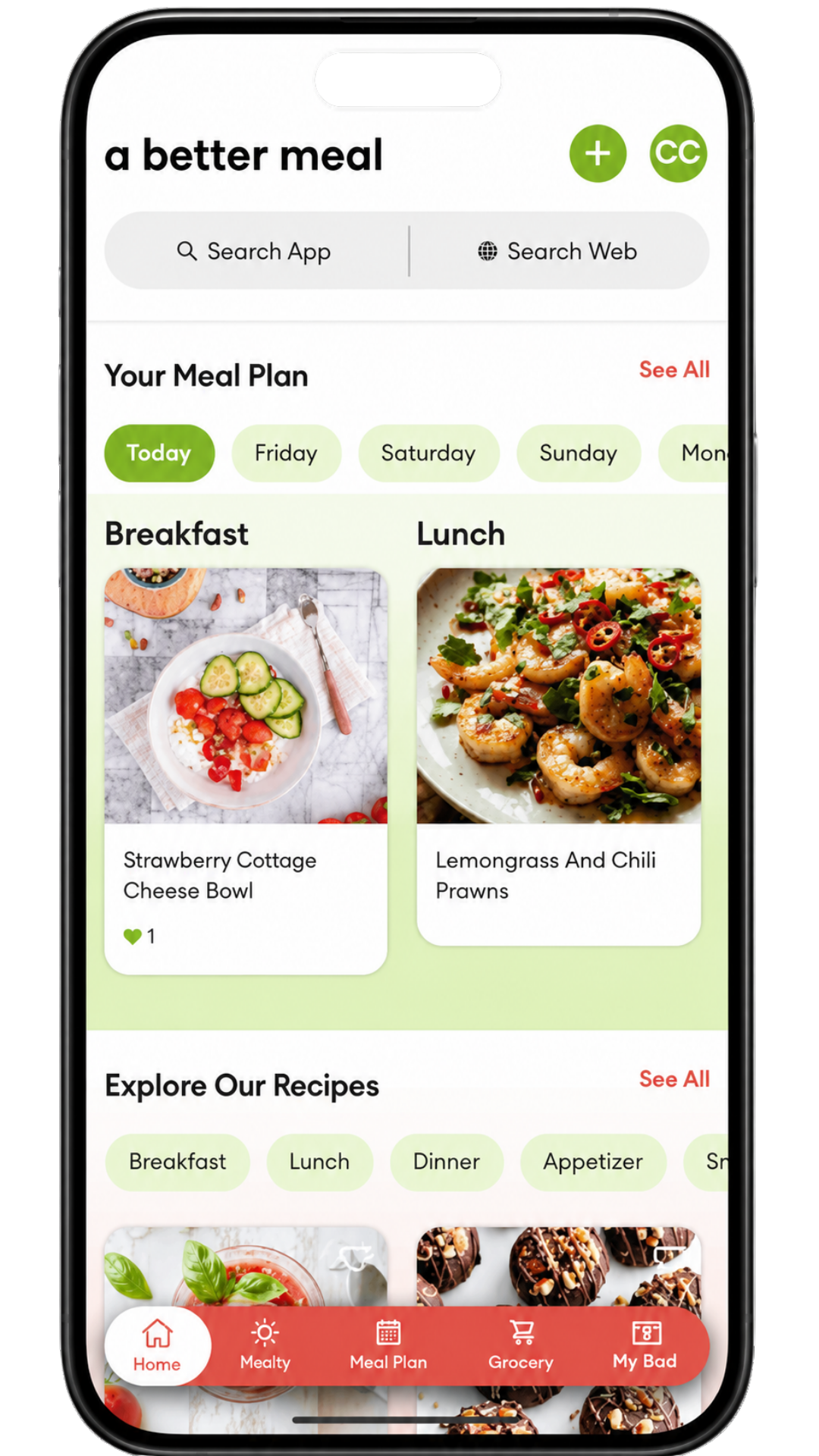
A Better Meal’s plan doesn’t start from a blank page. You tell it your goals, dietary preferences, allergies, foods to avoid, and what looks good, and the plan gets built from that instead of asking a household to invent a week from nothing.
Households that cook long enough usually have plenty of good dinners already. What’s missing is somewhere to put them so they actually get used on the right week. The plan is meant to be that place: not a blank slate waiting to be filled with someone else’s ideas, but a structure that a household’s own proven meals slot into, alongside whatever new ones fit the picture it described at onboarding.
Recipe import is where a household’s own proof carries over: the chili recipe traded at the office three winters running, the stuffing a grandmother has made since before anyone currently at the table was born, the enchiladas a neighbor drops off whenever someone in the house is sick. Bringing those in means the plan starts with dinners that have already been eaten and approved, rather than a fortnight of unfamiliar food while an app guesses at what the household likes. None of that proof ever needed a platform to travel. The channel it arrived by, whether that’s a family group chat, a screenshot, or a recipe box, doesn’t matter. What matters is that somebody already ran the experiment and it came back positive.
The grocery list comes off the plan in one action, and reads by aisle or by recipe. A proven dinner doesn’t just save a guess at the stove. It saves the guessing that would otherwise happen standing in an aisle too, staring at an ingredient nobody’s sure they need.
What a wrong guess actually costs
A recipe that turns out wrong doesn’t just cost thirty minutes at the stove. It costs whatever got bought for it: the herb bought for one dish and never used again, the sauce nobody liked poured down the drain, the extra loaf of bread bought as backup because nobody trusted the main plan to land. None of that shows up on a receipt as a mistake. It shows up as slightly more spent than the week needed, and slightly more thrown out than anyone meant to throw out.
A Better Meal is not a price optimizer. Its budget value is indirect: a settled plan reduces defensive shopping, duplicate purchases, and takeout drift. What changes is upstream of the receipt. Fewer dinners get bought for on a guess, which means less gets bought that never gets used.
Where a stranger’s five stars stop being proof
Ratings from people with no stake in a specific household’s Tuesday aren’t worthless, but they aren’t the same kind of evidence either. A five-star rating from ten thousand strangers is a real signal. It just isn’t a signal about this table, this week, or the eight-year-old who decided pasta was fine last month and has firm opinions about it now.
Anyone who’s cooked from an unfamiliar recipe site already knows the gap between a rating and reality: the one that promises “30 minutes, weeknight-friendly” and takes ninety, the one with four and a half stars and eleven reviews complaining it’s bland as written. A rating measures whether strangers, on average, didn’t hate something. It was never built to measure whether one specific household, on one specific Tuesday, would eat it without a fight.
A search result promises a recipe might be good. A recipe somebody already served promises it already was, to people with the same stakes a household actually has. The recipes most likely to survive a real week are the ones built for the household eating them, not the ones optimized for a general audience of strangers.
A meal that’s already worked somewhere else is evidence, not a guess, and it’s the kind a household doesn’t have to go generate itself, one disappointing Tuesday at a time. The plan carries that evidence forward instead of asking anyone to re-prove the same dinner twice. That’s what trust actually looks like on a Tuesday: not a promise that dinner will be perfect, but the quiet confidence that it’s already been tried, by people with something real at stake, and it held.
Less mental load. More room for everything else. That’s what the plan is for.
Stop thinking about dinner tonight ?