
Ask an AI grocery list generator for milk, eggs, chicken thighs, and rice, and it hands one back, categorized and clean, in about four seconds. Ask it whether the household actually needs chicken thighs this week, and it has nothing to say.
That gap is the whole story. Building a list is fast. Getting it right is slow, and those turn out to be two different jobs wearing one feature name.
Sales pages don’t make the distinction. “AI grocery list” gets stamped on an app that predicts your next reorder, an app that turns a spoken sentence into three tidy line items, and an app that’s really just a faster search box with better manners. All three ship under the same badge. Only one of them comes close to the decision a grocery list is supposed to represent, and it’s rarely the one doing the advertising.
“AI grocery list” is doing the work of three different features
Pull the label apart and there are three separate things hiding under it, and they’re not equally impressive once you know which is which.
The first is prediction. A household reorders paper towels every three weeks or so, and an automatic grocery list generator notices the pattern and floats the suggestion before anyone asks. That’s a real recommender system, trained on purchase history, doing genuine work.
The second is parsing. Say “add milk, eggs, and a rotisserie chicken” into a phone, and the app splits that sentence into three line items instead of one garbled string. That’s natural-language processing, and it’s a small, real piece of engineering. Nobody wants to type each item out by hand.
The third is neither. It’s a search box with better manners. Type “cereal” and it autocompletes to a brand name, the same trick search engines have run for twenty years, now wearing an AI badge because the badge sells better than “autocomplete” does.
The same fog sits over AI meal plans, where the word covers everything from a genuine recommender to a chat window with a friendlier tone of voice. Regulators have started drawing the line more carefully than the marketing does. A predictive-reorder feature and an autocomplete box don’t sit at the same tier under the EU’s AI Act, which sorts AI systems by actual risk rather than by whatever a product page claims, and NIST built an entire framework for trustworthy AI because “AI” stopped being specific enough to take on its own.
A Better Meal sits outside all three, on purpose. Its list isn’t trying to predict a reorder, parse a sentence, or dress up a search box. It’s a plain rule that pulls straight off a plan the household already decided on, which is a duller claim than “AI-powered” and also the accurate one. More on how that actually works in a minute, because the how matters less than the why.
The empty list is the part AI is actually good at
Credit where it’s due, because a fair amount of this genuinely helps. A list that starts half-full beats a list that starts empty, every time, and prediction is good at catching the boring staples nobody wants to remember on purpose: the paper towels, the coffee filters, the dish soap that’s somehow always just run out.
Voice and text parsing take out a smaller, but real, kind of friction too. Saying four items out loud while you’re carrying a laundry basket beats typing four items with one thumb. Having the app split that sentence into separate line items instead of one long string is a small convenience, and it adds up over a year of Tuesdays.
None of it is nothing. It’s just aimed at the wrong half of the problem. An AI grocery list that fills itself in is solving the part of the chore that was never actually hard, the typing, not the deciding.
A predictive suggestion for “two-percent milk, weekly” works fine right up until the household switches to oat milk for a month, and the app keeps quietly re-offering the wrong bottle anyway, standing in the fridge behind everything else while someone asks why there’s dairy milk in a house that went dairy-free. Prediction runs on the pattern that already existed. It has no way to know the pattern just changed, and no amount of retraining fixes a pattern nobody told it about yet.
The same blind spot shows up around allergies and things a household has simply stopped eating. A recommender trained on six months of shopping history doesn’t automatically drop an ingredient the day someone decides to cut it out. Somebody still has to go in and unteach the app, one purchase at a time, or just keep skipping the suggestion until it eventually gets the hint. That’s a household doing unpaid correction work on a system that’s confidently, repeatedly wrong, not artificial intelligence catching up to anything.
What an AI grocery list still can’t decide for you
Here’s the harder question none of the three features above are built to answer: does this household need chicken thighs this week at all?
A predictive list doesn’t know. It knows what got bought before. Whether tonight is actually chicken, or tacos, or the fourth plate of pasta this month, is a decision that happened somewhere the list was never invited into. Around a kitchen table, in someone’s head on the drive home, or not at all, which is its own kind of answer.
It can’t see the fridge, either. Most of these apps have no camera and no pantry sensor, nothing quietly checking what’s actually home. A smart list can just as easily suggest chicken that’s already thawing on the counter as it can leave off the one vegetable the house genuinely ran out of, because nobody told it either fact. Somebody ends up back from the store with a rotisserie chicken and a bag of chips anyway, because the list flagged neither the good news (there’s already protein at home) nor the actual gap: there’s nothing green left in the kitchen and dinner’s not far off.
A grocery list is downstream of a decision
Generating a list is the easy half of the job. Deciding what belongs on it is the hard half, and no amount of natural-language parsing touches that half, because the decision happened somewhere else entirely: in a meal plan, in a habit, in whatever got called out from the kitchen on a Tuesday.
A recommender can notice a household buys salmon every other Friday. It has no idea why that stopped two Fridays ago.
An AI grocery list is a record of a decision that already happened. It was never built to be the thing that makes the decision.
Fix the decision, and the list mostly writes itself from there. Fix the list instead, and the decision is still sitting there, unmade.
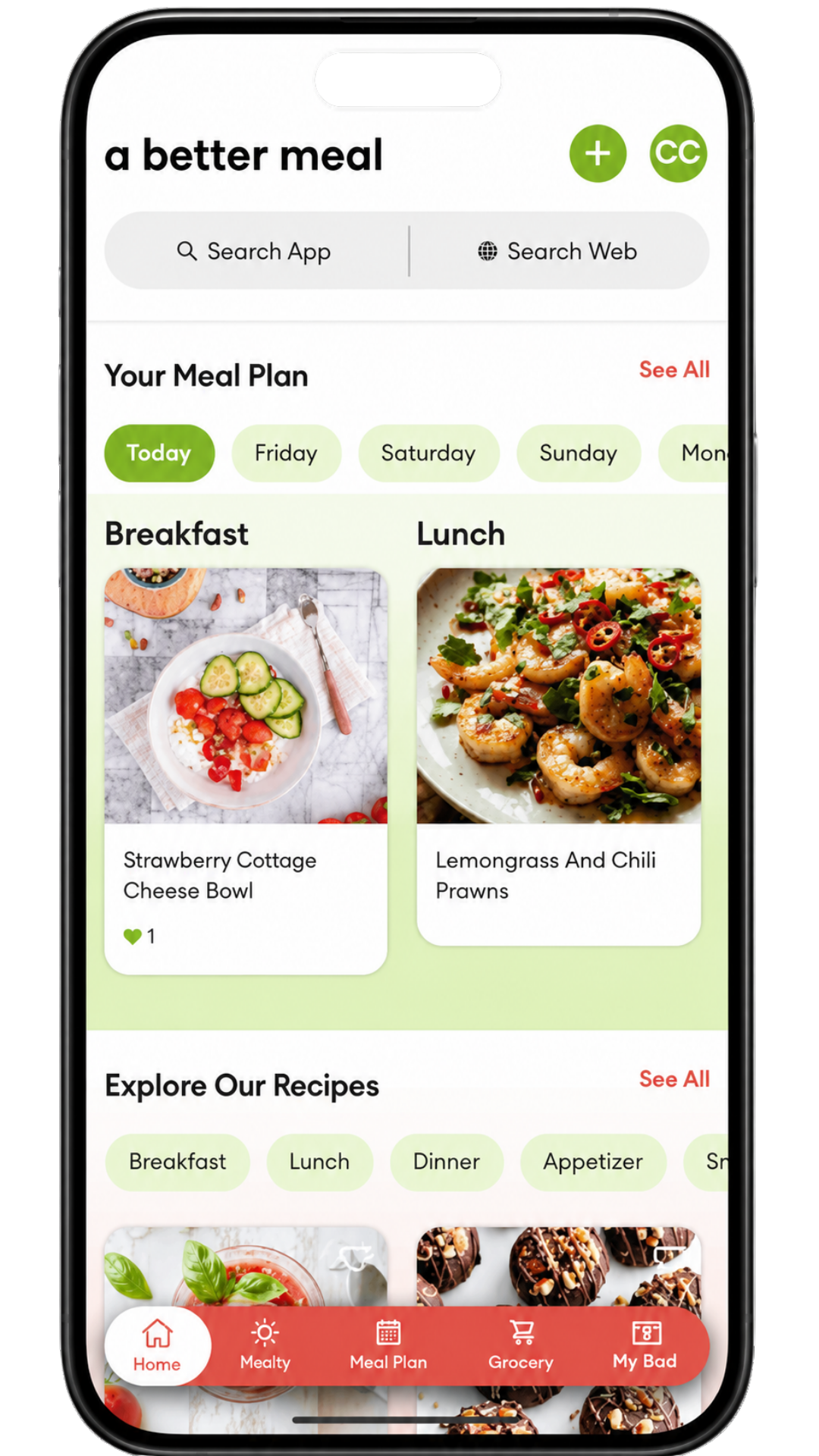
A Better Meal starts from the first half, and its own list isn’t an AI grocery list at all, not in the sense the word usually gets used. The list pulls straight off a plan the household already settled on. Predicting what to buy next was never the job. You tell it your goals, dietary preferences, allergies, foods to avoid, and what looks good. From that, A Better Meal builds a dinner plan instead of asking you to start from a blank page.
Once that plan exists, the list is one action away. Push a single recipe, several recipes, the next three days, or the next six, and the ingredients land on the list without anyone retyping them by hand. It can be viewed sorted by aisle, or by recipe if you’d rather keep the connection between a meal and its ingredients visible. Pulling ingredients off a recipe this way is the same mechanical step ABM already does well; the actual work happened earlier, at the plan, same as it does anywhere a recipe turns into a shopping list.
Nothing about any of that is guessing. An automatic grocery list generator that has to guess is solving a problem your plan already solved. A list that just extracts what the plan settled on doesn’t have to guess at all, which is a duller sentence than “AI-powered” and also the accurate one. When the plan changes, the list changes with it, because editing an item doesn’t touch the plan underneath it, and nothing gets re-predicted or re-guessed in the background while you’re not looking.
Six dinners, twenty-some ingredients, sent to the list in one push instead of trickling in item by item between texts about what’s actually still needed. That’s the difference a settled decision makes before anyone’s standing in an aisle wondering whether the fourth item on a mental list was cumin or coriander.
From plan to cart, without handing over the cart
A Better Meal can guide you through shopping online by opening a retailer search experience item by item. You still choose what actually lands in the cart, and you still check out yourself. You can see how the plan gets built in the first place before any of this starts.
That’s the shape of it, and it’s worth saying plainly because so much of this category blurs it: an AI grocery list generator that tries to do the deciding for you is solving the wrong problem twice, once by guessing at what belongs on the list, and again by quietly assuming you’d rather not be asked. A Better Meal doesn’t try either. The plan asks once, up front, when you actually have the headspace to answer. Everything after that, the list, the sorting, the send to the store, is mechanical on purpose.
One trip still means one trip. The list goes out as a single push, covering however many nights you sent to it, instead of turning into three separate half-remembered errands stitched together across the week. What’s on the list is what the plan already settled. What goes in the cart, and whether the ripe avocados win over the rock-hard ones, is still entirely up to you. The deciding got handled before you reached the parking lot. The choosing at the shelf never left your hands.
The plan you keep meaning to make? It’s already in the app.
See how the list gets decided before you shop ?