
It’s 5:42. The fridge door’s been open long enough that the light inside doesn’t feel special anymore, and nobody standing in front of it has said a word about dinner.
A kid wanders in and asks the question. Not politely, just: what’s for dinner. There’s a meeting that ran fifteen minutes long, still sitting in the body like caffeine that hit wrong. The takeout apps are right there, one thumb away, already logged in.
This is the moment “meal planning for working moms” gets typed into a phone late in the evening, half-search, half-complaint, by somebody who isn’t actually looking for a new recipe. They’re looking for the evening to stop asking them for one more decision.
Decision fatigue doesn’t audition for the role. It runs the whole show by evening, and the person standing at the fridge is usually the same person who did this yesterday, and the day before that.
Why the evening runs out before the decisions do
Cooking dinner is the easy part most nights. The hard part is the ten seconds before it: deciding what dinner even is, whether there’s enough of it, and whether the household will actually eat it once it exists.
That decision doesn’t cost much earlier in the day. By evening, it costs everything left in the tank. The brain that planned a call, packed lunches, and remembered a permission slip is not the same brain that gets asked, cold, to also invent tonight’s dinner. This is a battery problem. The mental tank that ran all day is already close to empty by the time dinner shows up on the list.
Psychologists have studied exactly this: making a lot of small decisions back to back leaves less capacity for the next one, no matter how minor any single decision is on its own. The APA’s overview of the research on decision-making fatigue is a fine primer if the mechanics are interesting. The practical version is simpler. By evening, the tank’s just closer to empty, and dinner is rarely the decision that gets first pick of what’s left in it.
The bag of snap peas from Sunday’s grocery run is still in the crisper, going a little soft, next to a question nobody’s answered about what they were actually for, while somebody in the next room asks, again, what’s for dinner.
Working parents don’t run out of time by evening, not exactly. Time’s still there. What’s gone is the appetite for one more choice, and dinner is rarely the first choice of the day. It’s the fortieth. The fiftieth. The one that finally breaks the run.
The pattern underneath the same four dinners
Most evenings don’t fail because nobody had time to cook. They fail because nobody had one more decision left in them by the time cooking became the thing to do.
That’s why the same four dinners keep coming back around. Falling back on a short rotation is what a depleted brain does: it reaches for the cheapest decision still available, the one it doesn’t have to think about.
Jasmine rice made for the whole table got eaten by half of it, because the seven-year-old decided overnight that rice was suddenly an insult, and the rest went into a container that’s still in the fridge three days later. Nobody planned for that. Nobody has the bandwidth to plan for that, on top of everything else the evening’s already asking for.
This is where meal planning starts to feel like a second job nobody applied for. A Better Meal exists for exactly this stretch of the evening, the part where the deciding, not the cooking, is what’s actually expensive.
Every week, the same decisions come back around, dressed slightly differently, and every week somebody has to make them fresh. That’s its own kind of tired, and it’s the subject of why weekly meal planning feels exhausting for busy people in the first place. The exhaustion comes from the deciding never staying solved, week after week, long before the cooking itself enters into it.
Two incomes usually means two people who spent the day making decisions somebody else needed made: what to say on the call, what to approve, what to reschedule. Dinner arrives at the exact moment both of those tanks are running on fumes at once, which is why the negotiation over who’s cooking can take longer than the cooking would have.
There’s a quieter effect worth naming plainly: some of the takeout nights that pile up aren’t really about wanting takeout. They happen when the evening runs out of decision-making capacity before it runs out of hours, and ordering is the one option on the table that doesn’t ask for another decision first. Nobody needs to feel bad about that. It’s a rational response to a depleted tank, not a character flaw, and it says more about how the evening is structured than about anyone’s discipline.
What a plan that survives the evening actually does
A plan that only works when the week goes exactly as expected is a hope wearing a grocery list.
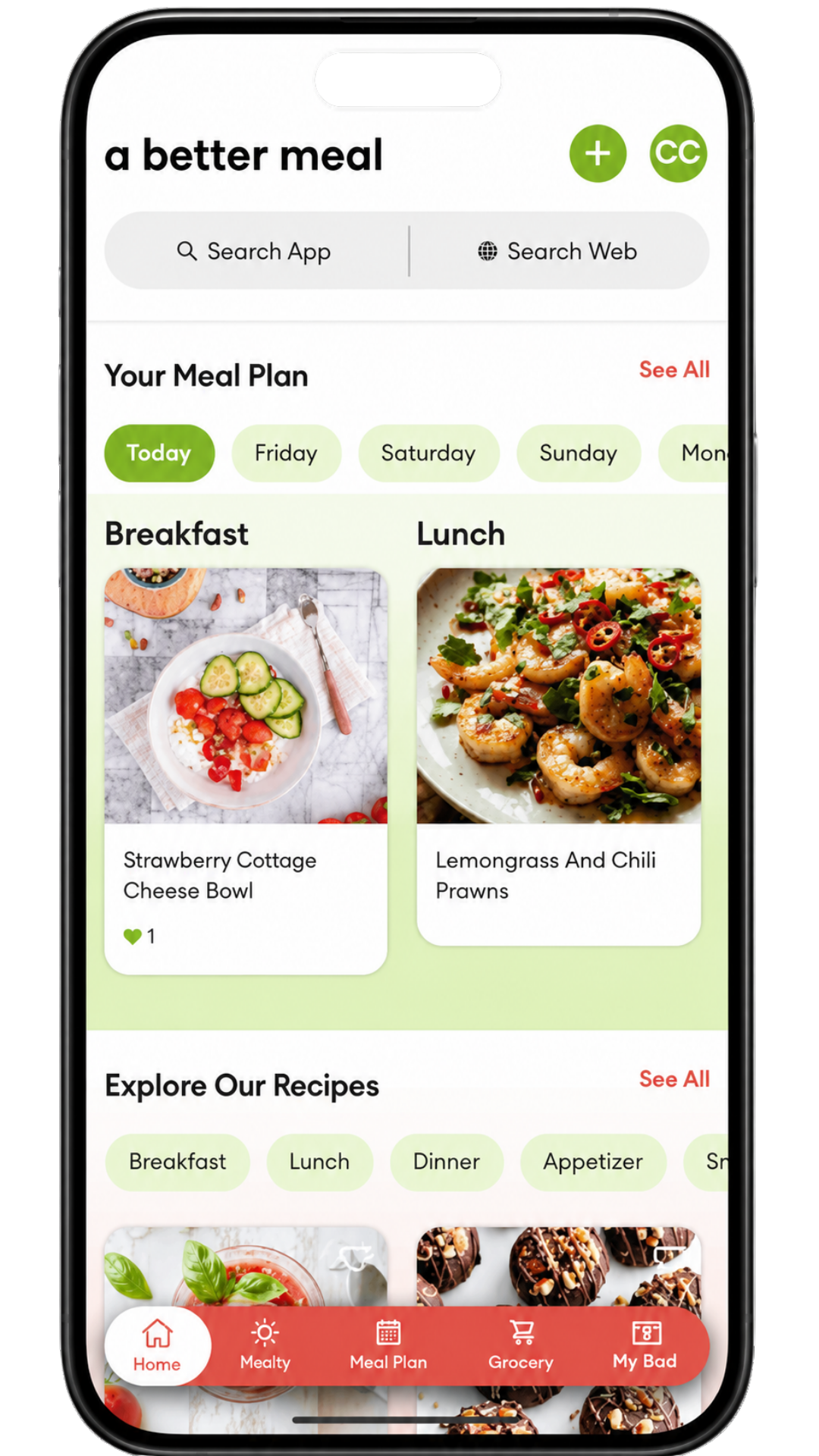
You tell A Better Meal your goals, dietary preferences, allergies, foods to avoid, and what looks good. From that, it builds a dinner plan instead of asking you to start from a blank page. A plan for the week exists before the week does: dinner decided before the fridge door opens, not during. That picture doesn’t get rebuilt from scratch every week either; the plan keeps working from it instead of asking the same questions again each Sunday.
When the week doesn’t cooperate, and it never fully does, you can use plan actions like reducing time, simplifying instructions, or choosing meals with fewer ingredients, instead of starting the whole week over from nothing. None of that depends on anyone remembering to update a plan sitting in their own head between now and Wednesday. The plan was built assuming the week would wobble; that’s the design brief, not an afterthought bolted onto a recipe box after the fact.
That’s the kind of thing a plan can promise and a system rebuilt fresh every Sunday can’t: showing up the same way on the worst week as the easiest one, which is worth more on a Wednesday than a clever idea would be.
The grocery list comes out of the plan already: generated in one action, sorted by aisle, and editing an item on it doesn’t touch the plan underneath. Shopping stops being its own decision.
A grocery run aimed at pork tenderloin came home with chicken thighs instead, because tenderloin had crept up in price again that week, and the evening wasn’t going to survive one more math problem on top of everything else. A plan that’s already decided the shape of the week absorbs a swap like that without falling apart. A plan that only exists in someone’s head has to be rebuilt from scratch every time something changes.
That’s the whole difference.
That’s the difference on an actual Tuesday too. See quick weeknight dinners when the plan does the thinking instead of the cook for what it looks like in practice, on a night that didn’t go the way anyone expected either.
None of this promises a spotless week. What changes is where the friction shows up. A grocery list sorted by aisle turns a rushed store run into fewer decisions too, which matters most on the nights the store trip itself is what got squeezed into a lunch break.
Dinner, handled
Generate your first plan in under two minutes


7-day free trial, then $6.99/month
or regular price $83.88 $39.99/year SAVE 50%+
Dinner, handled
Generate your first plan in under two minutes
7-day free trial, then $6.99/month
or regular price $83.88 $39.99/year SAVE 50%+
Why doing it yourself burns out by week two
The DIY version of meal planning looks reasonable on paper. Sunday, sit down, plan five dinners, write the list. It even works, for exactly one week, sometimes two.
What’s missing from most advice about weeknight cooking is the fact that the planning itself, not the cooking, is where the evening actually breaks. Sunday’s planner and Wednesday’s cook are the same person, but they’re not operating with the same amount of patience left. Sunday has coffee and a clear afternoon. Wednesday has a kid asking when food is happening and forty minutes before the next thing starts.
Four dinners went up on a Pinterest board back in January. One of them got made, twice. The other three are still saved, still unread, still doing nothing for anybody’s Tuesday.
By week three of most DIY attempts, the notebook page usually has more crossed-out meals on it than meals that actually got cooked as written. Nobody tried harder in week one than they did in week three. The version of the planner available by week three was simply more tired, running the same job on a smaller battery.
This is no knock on anyone’s Sunday effort. The plan somebody builds by hand on a Sunday afternoon is often genuinely good; the trouble shows up three days later, when the person keeping it running isn’t the well-rested version who built it. A system that depends on its maintainer staying fresh all week was always going to wobble, however good the first draft was.
A better system doesn’t fix that on its own, because the person maintaining the system is still the same depleted decision-maker, every single week, indefinitely. What actually helps is never having to be the system’s maintainer in the first place.
A working household usually doesn’t need more recipes to sort through. What actually helps is fewer things to decide about the ones already chosen, which is a different problem than the one most meal-planning advice tries to solve.
The search phrase “meal planning for working moms” usually assumes the missing ingredient is a better system to build. The real gap is simpler: never having to build one, every single week, alone.
The evening still has to happen. The deciding doesn’t have to be new every time
None of this erases a genuinely hard week. Some weeks the meeting runs long every single night, or somebody’s sick, or the whole schedule turns over twice before Wednesday. A plan doesn’t require the week to behave. It just means the evening isn’t also carrying the job of inventing dinner from nothing, on top of everything else it’s already carrying.
A plan that’s already there doesn’t need the week to be easy. It needs the deciding to already be done, which is a much smaller ask, and one that holds up on the weeks that don’t cooperate at all.
A plan that’s already decided by evening doesn’t remove the evening’s demands. The meeting still runs long. The kid still asks the question. What changes is that the answer already exists before anyone has to invent it. That’s most of what makes it possible to sit down at the table together, something worth protecting most nights, even on the ones the day didn’t cooperate with.
A plan that already exists by the time anyone’s standing at the fridge does more for the evening than any amount of getting-more-organized ever could, and it doesn’t ask the household to become different people to get there.
See what that actually looks like on the features page.
One fewer decision every evening. A little more evening left over. That’s what the plan is for.