
A family of five rarely has five people who want the same dinner. One’s just old enough to have opinions about texture. One still eats almost anything, for now. One’s on a practice or activity schedule that doesn’t line up with the other two most weeknights. That’s the situation before anyone’s decided what’s actually for dinner.
Meal planning for a family of 5 gets talked about like a slightly bigger version of planning for four: one more plate, a little more in the cart. What actually grows is the number of separate people one dinner has to satisfy, not the portion size. And the number of ways that dinner can fail grows right along with it.
Five is often the size where a household stops being an even number: a third kid, a grandparent moving in, two households blending into one. However it happens, five rarely splits into two neat groups the way four usually can, and most meal-planning advice written for “families” quietly assumes it will.
Why a Family of Five Feels Harder Than a Family of Four
Cooking one more portion barely registers at the stove. A bigger pot, a bit more rice. Done.
What changes happens earlier, before anything’s cooking. Four people can often be grouped into two pairs, or absorbed into “the kids eat this, the adults eat that.” Five tends to break that grouping. A toddler’s texture phase doesn’t match an eight-year-old’s opinions. A teenager’s practice schedule doesn’t match a toddler’s bedtime. Someone’s recently decided they don’t eat pork, and nobody’s told the person doing the cooking.
None of that is more food. It’s more constraints to satisfy with the same one dinner, on the same one night, before anyone’s hungry enough to stop negotiating.
There’s also a quieter shift that tends to show up somewhere around the fifth person: the plan stops being something one adult can just hold in their head. Two kids, most households manage that mentally: this one eats everything, that one skips mushrooms, done. A third kid, a fourth person’s schedule, and the mental version starts dropping details. Not because anyone’s less capable. There’s simply more to track than one head can reliably carry from Sunday to Thursday.
The Deciding Resets Every Time the Lineup Changes
It would be reasonable to assume five years of feeding a family of five eventually gets automatic. It doesn’t, because the lineup keeps changing. A toddler grows into a picky phase nobody planned for. A teenager’s practice schedule shifts every season. Someone’s cutting out dairy this month for reasons that have nothing to do with what was true last month.
The problem isn’t unfamiliarity. The exhaustion people report from weekly meal planning comes from something else: the answer that worked in March doesn’t necessarily work in June, for a household this size, and nobody sends a memo when it changes.
The usual fix is a rotation: five or six dinners everyone can live with, cooked on repeat until nobody complains. That holds for a while. Then someone ages out of liking one of them, or a new allergy shows up, or the rotation itself gets predictable enough that dinner turns into a low-grade argument. The rotation isn’t a bad idea, but it’s exposed to the same lineup changes as starting from scratch would be. It just takes longer to show, and by the time it does, everyone’s forgotten what made it work in the first place.
The high chair still has yesterday’s applesauce dried onto the tray, and the ten-year-old is home from practice wanting food now, not in twenty minutes.
That’s decision fatigue, and it doesn’t shrink with practice. It resets every time one of five people changes what they’ll eat, which for a household this size is often.
What a Plan Built for Five Different Eaters Looks Like
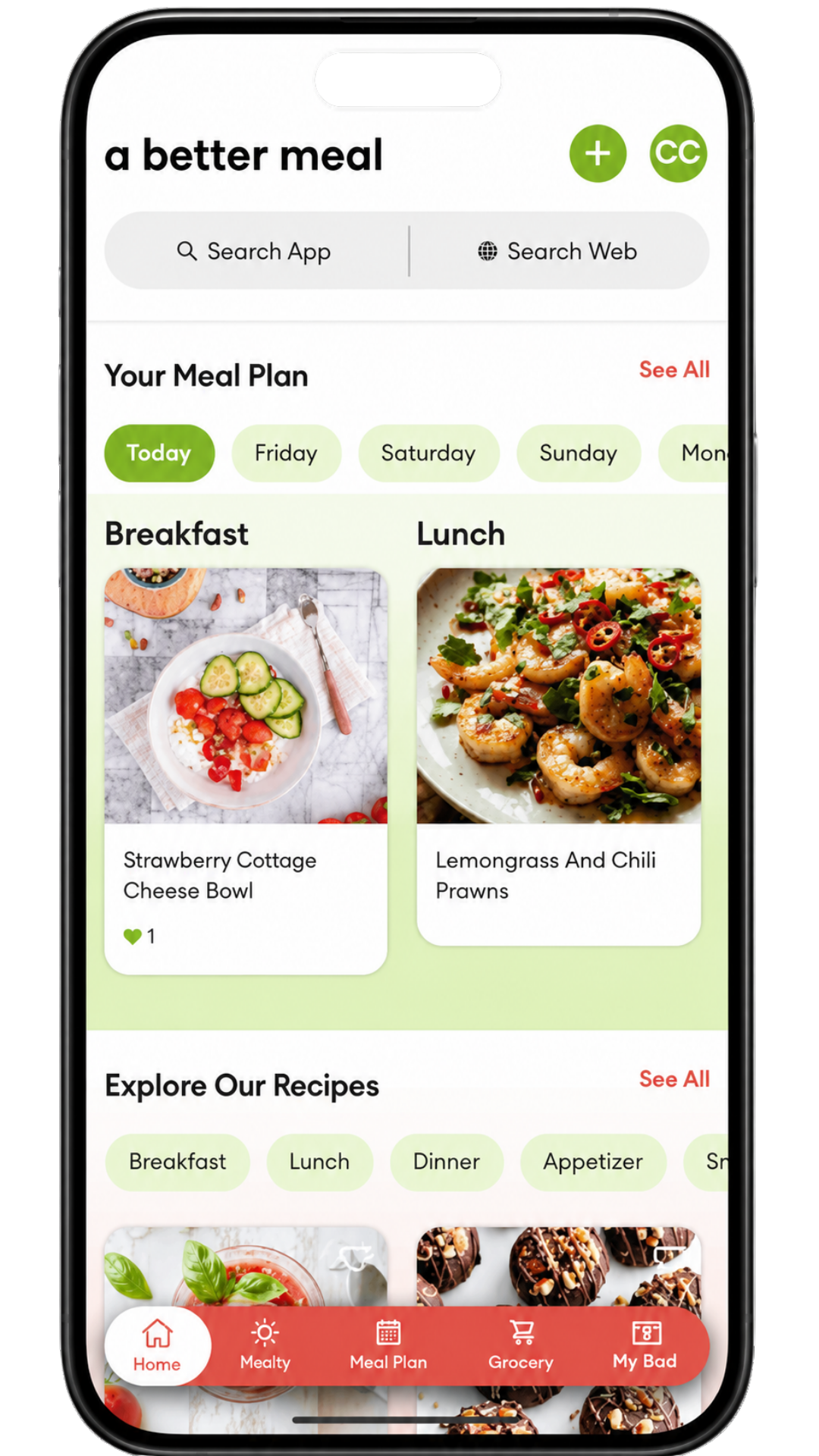
You tell A Better Meal your goals, dietary preferences, allergies, foods to avoid, and what looks good. From that, it builds a dinner plan instead of asking you to start from a blank page. That’s the household’s picture, given once, going into a plan built around it rather than a plan you assemble yourself, five people at a time.
That’s the input a plan actually needs for five different eaters: not one generic “family-friendly” setting, but the specific texture issue, the specific practice schedule, the specific thing someone stopped eating in March. It can also draw from your preferences, saved recipes, and past interactions so the plan is not just the same hand-built rotation every week.
At 5:30 there’s a pot of jasmine rice on and broccoli that may or may not survive contact with an eight-year-old who liked it fine last week. Whichever way that goes, the decision about whether tonight’s the night to try again already got made when the week did, not standing at the stove with everyone watching.
Five Different Eaters, One Dinner on the Table
Chicken thighs for five, snap peas nobody’s arguing about tonight, and a box of cheddar quesadillas in the freezer for whoever declares two bites in that they’re not eating this. That’s what feeding five different appetites actually looks like on a normal Tuesday, backup included, not a failure of planning.
A household of five without a plan tends to default to whichever meal is least likely to start a fight: the same four or five dinners on repeat, because introducing anything new risks a table full of complaints on a night there’s no energy left to referee one. That’s avoidance dressed up as a routine, not variety, and it’s a narrower five nights than the household would actually pick given the choice.
Running two kitchens because one person won’t eat what the rest of the table is having is the instinct, and it’s the thing a household-built plan is meant to spare you. Five different appetites doesn’t have to mean five different dinners, or even a constant negotiation over which one gets made twice. It means the plan was built with all five in mind before anyone stood at the stove weighing who to disappoint tonight.
When the week gets hard anyway, you can use plan actions like reducing time, simplifying instructions, or choosing meals with fewer ingredients, instead of scrapping the night’s dinner and starting over standing at the fridge.
The recipes this household already trusts can come into the plan too, so the dinners that already work for five people don’t get lost in a saved folder somewhere while a stranger’s recipe takes Tuesday. That matters more here than it would for a smaller table. The fewer meals a household has to re-litigate from scratch, the less of the week’s decision-making is starting cold, and the more of the week that’s already settled before Monday arrives.
4.8 from 2,400 App Store reviews
Trusted by 50,000 families
“Finally an app that actually plans my week instead of just saving recipes. — Sarah, App Store”
4.8 from 2,400 App Store reviews
Trusted by 50,000 families
“Finally an app that actually plans my week instead of just saving recipes. — Sarah, App Store”
What the Plan Takes Off a Household This Size
The plan is the product, not a set of tools the household operates to build one itself. For five people, the deciding is done before anyone opens the app, which is the difference between a plan and a place to make one.
The grocery list a family actually needs comes straight out of the plan in one action, sorted by aisle so the trip doesn’t backtrack, and edits to it don’t touch the plan underneath. Cross something off because the pantry’s already got it, or because Tuesday’s dinner changed, and the rest of the list stays exactly as it was. A Better Meal can guide you through shopping online by opening a retailer search experience item by item. You still choose the products and check out yourself. Close to fifty grocery and delivery services are on the roster, from the store the household already uses to a few it might not have tried yet.
See what the plan actually does before it ever reaches the kitchen, and it starts to make sense why the shopping was never the hard part for a household this size. The list was only ever going to be one stop long regardless of whether three people were eating off it or five; what changes the trip is how many separate decisions the plan already absorbed before anyone picked up a cart.
By the time the list is in your hand, it’s already been checked against the plan once. That’s one less thing to verify on a night there’s no bandwidth left for verifying anything, which for a family of five is most of them.
None of it is fixed. Swap Wednesday’s dinner for something else, drop a night entirely, or leave the whole week exactly as it arrived and just cook. The plan is where the deciding happened; what the household does with it from there is still up to the household.
Meal Planning for a Family of Five: Questions People Ask
How is meal planning for a family of five different from planning for four? A plan built for a family of four often assumes two adults and roughly matched kids. Five is usually where that assumption stops holding, not because there’s more food to make, but because there’s another set of preferences and another schedule folded into the same one dinner.
What if one of the five won’t eat what the others eat? That’s the ordinary case for a household this size, not the exception. A plan built around the whole household picks meals everyone at the table can eat before anyone’s standing at the stove negotiating, so the deciding happened once, earlier, instead of every night at six. One holdout doesn’t have to mean a second dinner gets cooked alongside the first.
Does the plan account for a picky toddler and an independent teenager at the same table? It works from what the household tells it — dietary preferences, allergies, foods to avoid, the recipes people already like — not from reading anyone’s mood at the table. That’s enough to keep a toddler’s texture phase and a teenager’s opinions inside the same week without either one derailing it, and it’s steadier to plan around than however Tuesday happens to be going.
Is grocery shopping harder for a family of five? The shopping itself is still one list, built from one plan, in one action. That part doesn’t get harder with five people. What’s harder sits upstream of the list: getting five people’s week decided in the first place. A household with more people at the table than the U.S. average also tends to run more backup dinners when the first choice gets refused, and unfinished backup meals are a real share of what a household throws away in a normal week. A plan handled once, for everyone at the table, means fewer of those get cooked and abandoned in the first place.
The Short Version
Meal planning for a family of 5 was never really about the extra plate. The math is the easy part. What actually gets heavier is the deciding: reconciling five sets of preferences and schedules into one dinner, night after night, with the lineup quietly changing underneath it. That’s the part a plan is built to carry, so it isn’t sitting on one person alone every night.
Less mental load. More room for everything else. That’s what the plan is for.
Get your family’s meal plan ?