The nine-year-old at the table has never once asked what his protein target is. He has a position on chickpeas, and that’s the entirety of his nutritional philosophy.
Software confuses those two things constantly. Hitting a number is arithmetic. Getting four people fed on a Tuesday, on whatever energy is left at the end of a working day, is a negotiation.
Eat This Much is genuinely good at the arithmetic. A Better Meal exists to settle the dinner question the negotiation is stuck on, and it’s worth knowing which one you’re asking about before you pick a tool, because both apps will hand you something called a meal plan and they mean completely different things by it.
What Eat This Much is actually built to do
Start with its own description. It creates “personalized meal plans based on your food preferences, budget, and schedule”, and the inputs it asks for tell you everything: a calorie target, how many meals you want, minimums for carbs, fat and protein, and a diet type off a fixed list.
Give it a number, get back a day of food that hits the number. That’s the machine, and by the standards of nutrition engines it’s a good one. Fast, accurate, honest about what it is.
The paid tier adds planning a week at a time, an automatic grocery list, delivery integration and automatic leftovers. The free tier does daily plans and tracks what you eat.
Notice what sits at the centre of all of it. The target.
Where a calorie target and a household part ways
A target is a property of one person. Dinner is a property of a room.
Everything downstream follows from that. A plan built around 2,100 calories and a protein floor is built for exactly one body. Add a second body with different numbers, a third that’s nine and has no numbers, and a fourth who won’t eat fish, and the target stops being the organising idea. It becomes one constraint among several, and not the loudest one.
You can taste it in the output. Six ounces of tilapia and three-quarters of a cup of brown rice is a correct answer to a macro question. It’s a hard sell at 6:30 on a Tuesday to a table where nobody is tracking anything and one person is holding out for the chickpea thing from last week.
A plan built on macros misses what a household needs for reasons that have nothing to do with the macros being wrong. They’re usually right. They’re just not the thing standing between you and dinner.
The Professional tier tells you who it’s for
The clearest signal isn’t in the marketing. It’s on the pricing page.
The company sells a Professional tier for health and fitness professionals: manage clients in one dashboard, custom plans per client, your own branding, email plans and grocery lists out to people.
That’s a coherent product with a coherent customer. A dietitian with a caseload. A coach with twelve clients on twelve targets. The tool is shaped for a practitioner administering nutrition to individuals, and the version you use at home is that same engine, pointed at your own body.
None of that is a criticism. It’s a description, and it’s the most useful fact in this comparison. If you’re one person with a number to hit, the fit is real.
Counting is solved. Dinner is the open question.
Worth sitting with this one.
Nutrition arithmetic got solved decades ago. The numbers aren’t controversial, the software is mature, and if you want a day of food that lands on a macro split, several apps will do it in seconds and Eat This Much will do it well.
The question nobody solved is the one that comes back every single night. What are these specific people eating, and who decided?
That has no numerical answer. It has a household answer, and it depends on the nine-year-old’s current position on chickpeas, whether Wednesday has a late pickup in it, and whether anyone still has the energy to cook the thing that got planned. A calculator can’t reach any of that, and it isn’t the calculator’s fault.
What a plan owes a household that a target doesn’t
A target owes you accuracy. A plan owes you a week that holds.
Those are different debts. Accuracy means the numbers add up. Holding means Thursday still works after Tuesday went sideways, that the food is food these particular people eat, and that nothing has to be rebuilt when the week bends. The plan a family will actually follow beats the perfect one on paper, and a plan nobody eats scores beautifully right up until it’s scraped into the bin.
There’s a quieter difference underneath, about who’s carrying the load. A target-based plan is upfront that you’re the one operating it. You set the number, you approve the swaps, you log the food at 9:40 at night against a bowl you finished two hours ago. For someone chasing a body-composition goal, that’s a fair deal and the logging is part of the point.
A household doesn’t want to operate anything at 6:30. It wants dinner to have been decided. That’s a different promise from a personalized plan that arrives as a spreadsheet, however well the spreadsheet adds up.
As Mark Semmelbeck, who founded A Better Meal, puts it: “You shouldn’t have to think this much in the first place.” The line does real work in a comparison like this one. Both tools remove effort. Only one of them is aimed at the thinking, and the thinking is what’s actually gone by Tuesday evening.
Who should use Eat This Much, honestly
Straight answer, because an honest one is more useful than a rigged comparison.
Use Eat This Much if you’re feeding one person, that person is you, there’s a number attached, and you want the food to hit it. Cutting, bulking, a macro split from a coach, a framework you’re following closely. It’s built for exactly that, it does the arithmetic better than you will by hand, and the grocery list and the Instacart handoff are a real convenience on top.
Don’t ask it to be a family dinner plan. It isn’t one and it never claimed to be. Pointing a nutrition engine at a household and expecting dinner to get settled is a category error, and it’ll feel like one by the second week. The same mismatch shows up when a plan gets confused with a workspace.
A plan the table will actually eat
A Better Meal starts from the room, not the number.
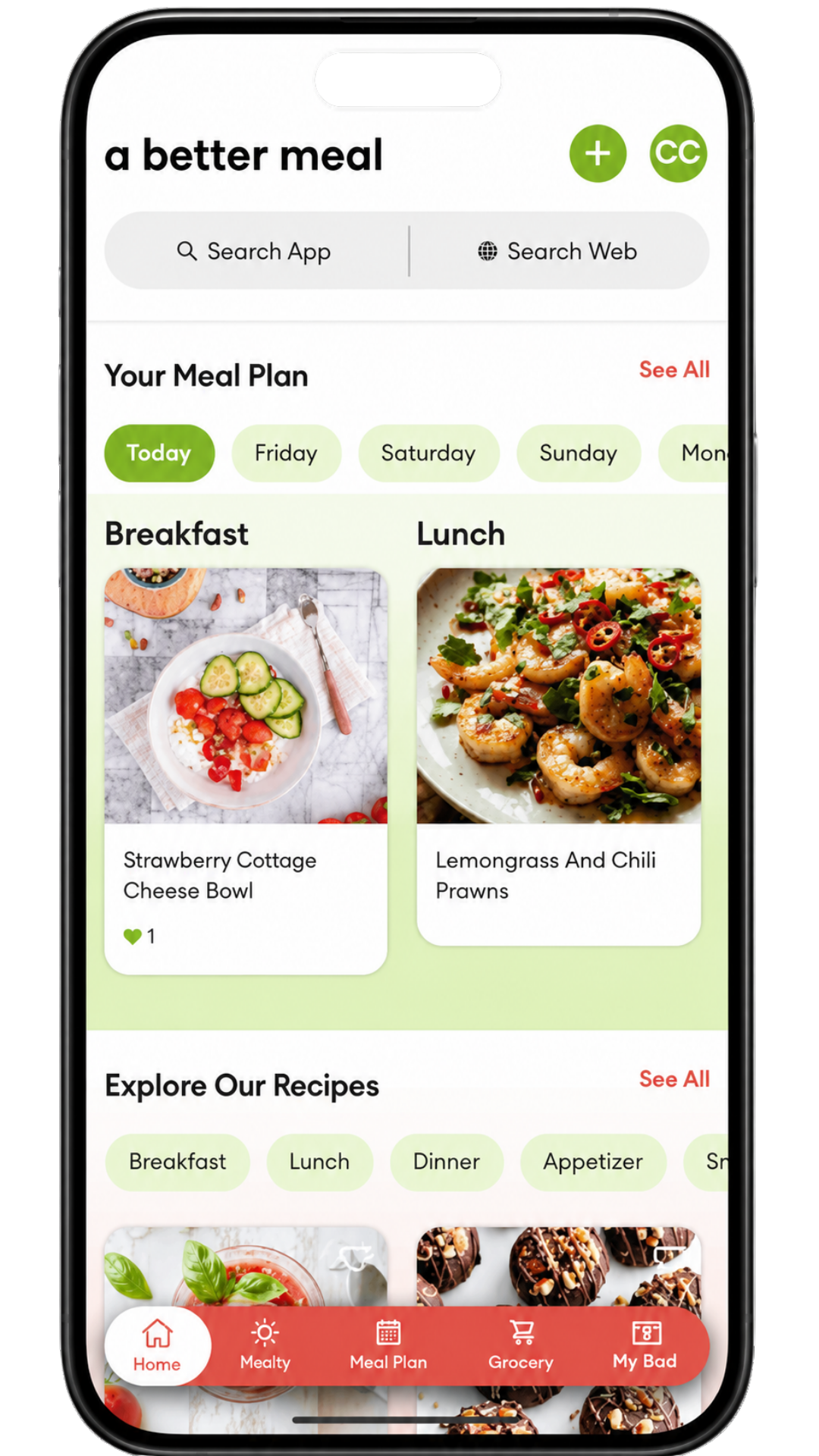
You tell it your goals, your dietary preferences, any allergies, the foods to avoid, and what looks good. From that, A Better Meal builds a dinner plan instead of asking you to start from a blank page, and it’s sitting there when you open the app, so you’re not rebuilding the week from scratch every Sunday. Bring your own recipes in too, the ones the household already trusts.
The grocery list comes out of the plan in one action, sorted by aisle. Cross something off because it’s already in the cupboard, and the week stays standing.
Some things it won’t do, and they’re worth naming next to a tracking app. It isn’t a calorie tracker or a macro optimizer. Recipe pages may show nutrition estimates, but it doesn’t log your food and it doesn’t build the day around a numeric target. If that’s what you came for, the tracking app is the better tool and this is an easy call. Here’s what A Better Meal actually does.
Two questions. Two tools. The mistake was never picking the wrong one. It’s not noticing there were two.
Open the app. The plan’s already there.