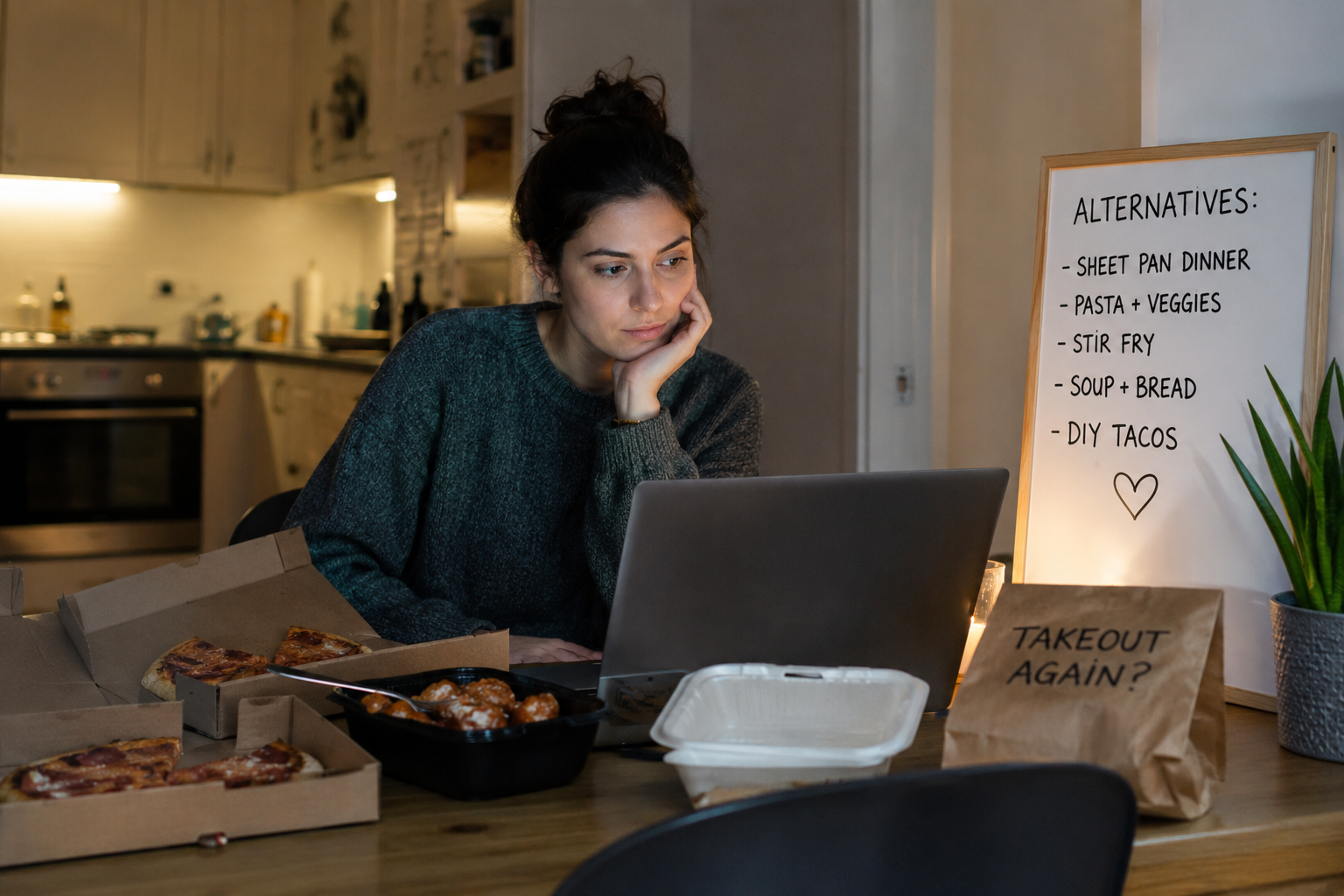
Weeknight takeout has a way of becoming the default. Not because anyone wanted it that way. By 6 p.m. on a Tuesday, with three other decisions still on the pile and a kid asking what’s for dinner, “alternatives to takeout” requires more energy than the household has left. The order goes in. Again. The loop repeats next week.
If that sounds like your Tuesday, you haven’t been failing at dinner. You’ve been carrying a system that asks the most depleted person in the house to also be the meal planner, the grocery-list maker, and the cook. The system was the problem before takeout was the symptom.
This is the version of alternatives to takeout that actually holds up: why the default keeps winning, what’s underneath it, and the shape of a plan that beats it without becoming one more thing on your list.
Why Weeknight Takeout Keeps Winning
The standard explanation is laziness or “busy schedules.” Neither holds up under a closer look. Weeknight takeout wins because takeout doesn’t require a decision at the moment your decision-making is most spent. You open a familiar app. You re-order what worked last time. Two taps, maybe three. The same Thai place you’ve ordered from since the kid was in kindergarten. The same butter chicken. The same kid-friendly side that doesn’t get sent back. The mental cost is close to zero.
Cooking, at the same moment, costs much more. Picking the meal. Checking what’s in the fridge. Deciding on a backup if half an ingredient is missing. Negotiating with whoever’s in the house about what they’ll eat. Each of those is a small decision, and at 6 p.m., small decisions cost more than they did at 11 a.m.
The math is honest. Takeout wins because it does the one thing the cook can’t do at 6 p.m., which is decide.
The Decision-Fatigue Loop You Didn’t Sign Up For
The pattern is predictable. Sunday, you have energy. Maybe a coffee in hand, browser open to a meal-planning Pinterest board you’ve never actually used. A few meals get rough-planned, a vague idea about Tuesday’s chicken, a note about defrosting something. Monday holds. Tuesday wobbles. By Wednesday, the gap between the plan and the reality is wide enough that the takeout app is the only thing that fits the moment. Thursday and Friday don’t even pretend to try.
That’s not a willpower problem. That’s a plan-design problem wearing a willpower disguise. A plan that needs Wednesday’s energy to keep itself going was never built for a real week. The decision fatigue isn’t a personal weakness. It’s the natural output of a system that asks for fresh decision-making capacity exactly when capacity is gone.
Takeout doesn’t fix that. It removes one decision by handing it off to an app the household already trusts. The cost shows up at the end of the month, when the takeout total is its own line item and the fridge still holds the produce that didn’t get used.
Why Most “Alternatives to Takeout” Don’t Stick
Most advice on alternatives to takeout assumes the missing piece is recipes. New ideas. A list of fast weeknight meals. Five sheet-pan dinners. The internet is full of these. They are not what’s missing.
You’ve probably searched “fast weeknight dinners” at 5:42 PM on a Tuesday before. You’ve probably opened three tabs, found a sheet-pan recipe that needs an ingredient you don’t have, scrolled past two more, given up, and reached for the takeout app. The recipes aren’t the problem. The recipes are doing their job. The cook is the one without the bandwidth to use them, at exactly the time of day they’re needed.
The missing piece is that at 6 p.m., the question “what should I make tonight” doesn’t have a fast answer in the cook’s head. Any alternative to takeout that asks you to answer that question just before dinner is competing against an app that already knows the answer. It’s the wrong fight.
The pattern worth naming: a solution to weeknight takeout that begins with “decide what to cook” isn’t a solution. It’s a restatement of the problem with a recipe attached.
What an Actual Alternative to Takeout Looks Like
An alternative to takeout that holds up has to do two things at once.
Picture Wednesday at 5:40 PM. Backpack on the floor. Someone changing out of work clothes. The radiator clanging. The cook isn’t standing there thinking “what sounds best tonight.” The cook is thinking “what can be on the table in 25 minutes without a store run.” Whatever decides for that moment is the alternative. Everything else is theater.
It has to remove the 6 p.m. decision. The night’s meal can’t be a decision the cook makes at the moment of greatest depletion. It has to have been decided earlier, by something whose decision-making capacity wasn’t already spent.
It also has to survive contact with the actual week. The plan can’t assume the household stayed on schedule, that the produce got used at the right pace, or that Wednesday energy looks like Sunday energy. A plan that breaks the first time the week wobbles isn’t a plan.
The shape that fits both is a plan that exists before the week starts and bends when the week deviates. The decisions are made once, by a system that isn’t tired. The cook arrives at 6 p.m. to a dinner that’s already decided.
Where the DIY Version Falls Apart
The do-it-yourself version of weeknight meal planning — the Sunday hour, the notebook, the open Pinterest tab — works in concept and breaks in practice. Two reasons.
The first is that the planner is the same person as the cook. Sunday’s enthusiasm builds the plan; Wednesday’s exhaustion runs the kitchen. Sunday-you has a chef’s mood, a clean counter, a Pinterest board. Wednesday-you has a half-defrosted chicken breast and 23 minutes. The handoff between those two versions of the same person is where weeknight plans collapse.
The second is that the DIY plan is brittle. It’s built around specific recipes for specific nights. The first deviation breaks it: a late pickup, a missing ingredient, a kid who suddenly won’t eat peppers. The structure was made of rigid pieces.
A plan that survives the week doesn’t ask the cook to be both the planner and the executor. The planning has already happened. The cook is executing what’s already been decided.
Where A Better Meal Fits Into Alternatives to Takeout
A Better Meal is built on one idea: the plan is the product. Not a recipe library you sort through. Not a tool you use to plan your week yourself. A plan for your household that’s already there when you open the app.
What that means in practice: the meal is decided before 6 p.m. The grocery list comes out of the plan, not the other way around. The plan is built around the household it has to feed. The kid who won’t touch sauce. The adult who can’t do dairy. The Wednesday that’s always tight because of soccer. The Friday that always wants to be easy. The plan knows what your household actually eats, not what looks good on a recipe card. When the week deviates, the plan adapts; when it holds, the plan executes.
The point of this isn’t “use A Better Meal to plan your meals more efficiently.” That’s still asking you to do the work. The point is that you stop doing the work. The plan does it. The cook executes. The 6 p.m. decision that takeout was solving for stops being a decision at all.
The Plan, Not the Planner
The most useful frame for thinking about alternatives to takeout isn’t “what should I cook instead.” It’s: what would have to be true at 6 p.m. for cooking to feel as easy as ordering? Most of what’s required isn’t physical. It’s cognitive. The decision is already made. The variation is already accounted for. The cook is executing, not deciding.
Takeout will keep winning as long as the alternative asks the cook for the same capacity takeout removes. The real alternative isn’t another recipe list. It’s a system that handles the planning the cook can’t, at the moment the cook can’t.
Less mental load. More room for everything else. That’s what the plan is for.
FAQs
1. Why does takeout become the default during the week?
Busy schedules, exhaustion, and lack of meal preparation often make takeout feel faster and easier than cooking.
2. What are easy alternatives to takeout?
Quick meals like wraps, pasta, rice bowls, soups, sheet-pan dinners, and frozen ingredient combinations can save time.
3. Can meal planning reduce takeout habits?
Yes, even simple meal planning can make home cooking more convenient and reduce last-minute food orders.
4. Why does cooking feel exhausting after work?
Mental fatigue, stress, and decision overload can reduce motivation to cook during busy evenings.
5. Are healthy weeknight meals possible without a lot of effort?
Yes, many balanced meals can be prepared quickly using simple ingredients and easy recipes.