
A shared grocery list is the easiest problem in a kitchen to solve on paper. Two people, one list, one trip: it’s the same promise every shared grocery list app makes, going back to the pad stuck to the fridge. For a few days it works exactly like that. Someone writes “milk” on the pad, someone else adds “coffee filters” underneath it in different handwriting, and the fridge fills back up on schedule, the way it’s supposed to.
Then one Wednesday the pad’s still on the counter, the milk still isn’t in the house, and neither person remembers deciding who was supposed to go. Nobody did anything wrong here. The system just quietly needed something it never asked for out loud: two people paying attention to the same object at the same moment, every single week, without fail.
That’s the gap these apps are supposed to close. Most of the ones built for it lean hard on one idea: sync. Add an item on your phone, it shows up on theirs, instantly, the way a text does. It’s a real feature, and it solves a real annoyance. It’s not, by itself, the thing that makes a list actually shared.
What people mean when they search for a “shared grocery list app”
Search “shared grocery list app” and the results mostly promise the same thing in different words: real-time updates, live sync, a little badge showing who added what and when. The pitch is presence. Both people watching the same list change in front of them, the way a shared document does, so nobody’s ever looking at a stale version.
That pitch answers a narrower question than the one most households are actually asking. The real question isn’t “can we both see the list at the same time.” It’s “why does the list exist at all, and who decided what’s on it.” A list that updates instantly but still gets rebuilt from scratch every week, by whoever remembers to build it, hasn’t solved the problem. It’s solved the visibility problem and left the decision problem exactly where it was.
Search intent around a shared grocery list actually splits into two different asks, even when the keyword looks identical. Some searchers want a live, collaborative checklist for a single shopping trip, closer to an errand-splitting tool for one afternoon. Others want something closer to a standing household system: a shared family grocery list that reflects the same plan week after week, without either person rebuilding it. This piece is about the second kind. It’s the one that actually changes a household’s week, not just one Saturday of it.
Why real-time sync isn’t what makes a list feel shared
Here’s the part that’s easy to miss: two people can watch the exact same list update in real time and still not feel like they’re sharing the job. One person is still doing all the noticing: the coffee’s low, the snack drawer’s empty, Thursday needs one more ingredient. The other person is just watching the results arrive on their own phone. Sync makes that division of labor faster to see. It does nothing to change who’s doing the noticing in the first place.
That split isn’t a guess. Government researchers tracking household grocery shopping found the task is rarely divided evenly: most shoppers report doing “a lot” or “all” of it, not “some,” which means one person is usually carrying it whether or not both names are on the app. Sync speeds up a symptom. It doesn’t touch the underlying split.
Genuinely sharing groceries means neither person is doing all the deciding alone. Both phones buzzing at the same second has very little to do with it. That’s a planning problem, not a syncing problem, and no amount of instant refresh fixes it. Fixing it means the list has to come from somewhere other than one person’s memory in the first place. That’s exactly the layer a plan-first app like A Better Meal is built around. Not the refresh rate. Who did the deciding.
There’s a second, quieter cost to chasing the live-sync promise. It puts the burden back on the reader to keep the list current in the moment: checking it, updating it, cross-referencing what the other person already added. That’s still work. It’s just faster work, spread across two phones instead of one notepad. A household doesn’t need the checking to be faster. It needs less to check.
What actually makes a grocery list shared: one plan, not one live feed
A shared grocery list app earns the word “shared” the same way a shared calendar does: not because it updates the instant someone touches it, but because both people are working off the same thing, decided once, ahead of time. The calendar doesn’t need to ping the second someone adds a meeting to feel shared. It’s shared because everyone’s looking at the same version of the week, whether they open it Monday morning or Thursday night.
The same logic holds for a shared family grocery list. If the list falls out of a plan, a real week of dinners, already decided, both shoppers are shopping against that plan whether or not the app pings anyone the moment something changes. Nobody has to remember to text “did you get milk.” The list already answered that before either person left the house.
This is the honest version of “shared.” Not two screens mirroring each other in real time. One plan that both people are shopping from, so the grocery list means the same thing no matter which phone it’s open on, and no matter which person happens to be standing in the store that week.
Where two-person households actually collide over groceries
The friction in a two-person or family household rarely shows up as “the app was slow to update.” It shows up smaller and dumber than that, and usually at the store, not on a screen.
- Two jars of peanut butter in the cart, because nobody checked what was already in the pantry before the store run.
- A gallon of milk picked up twice in the same week, and skipped entirely the third.
- One person clearing the whole list at the store while the other one, half an hour later, adds the single thing that actually mattered for dinner.
- A running disagreement about whose handwriting that item even is, and whether it’s still needed or already got bought Tuesday.
- The list itself splitting in two, one version on a phone, one taped to a cabinet, each missing what the other has.
- A third person in the house, a teenager or a roommate, who genuinely doesn’t know a list exists at all, because nobody thought to hand it to them.
Small stuff, every one of it. None of it is a technology problem in the way a “shared grocery list app” pitch implies. It’s a coordination problem, and coordination problems get worse, not better, when more people are looped in without a shared starting point.
None of these are solved by speed. They’re solved by the list meaning the same thing to both people before either one is standing in an aisle deciding what to do with it. A shared family grocery list that comes from a settled plan doesn’t need real-time updates to prevent the duplicate peanut butter. It prevents it because the list was never built twice in the first place. One plan produced it. Two people are shopping from the same copy of the same decision.
Even the EPA’s own advice on cutting household food waste lands on the same point from a different angle: shop from a list built around what the week actually needs, and you’re a lot less likely to buy what you don’t. A shared list built from a plan is that advice, just applied to two people instead of one.
This is where a shared list has to earn its keep on the household dimension specifically, not just the individual one. A single person’s grocery list only has to remember what one person wants. A shared one has to hold up when two or more people are deciding, shopping, and cooking against it, sometimes in the same week, sometimes the same night, without either person needing to check in constantly to make sure they’re not duplicating or missing something.

What a shared grocery list looks like inside A Better Meal
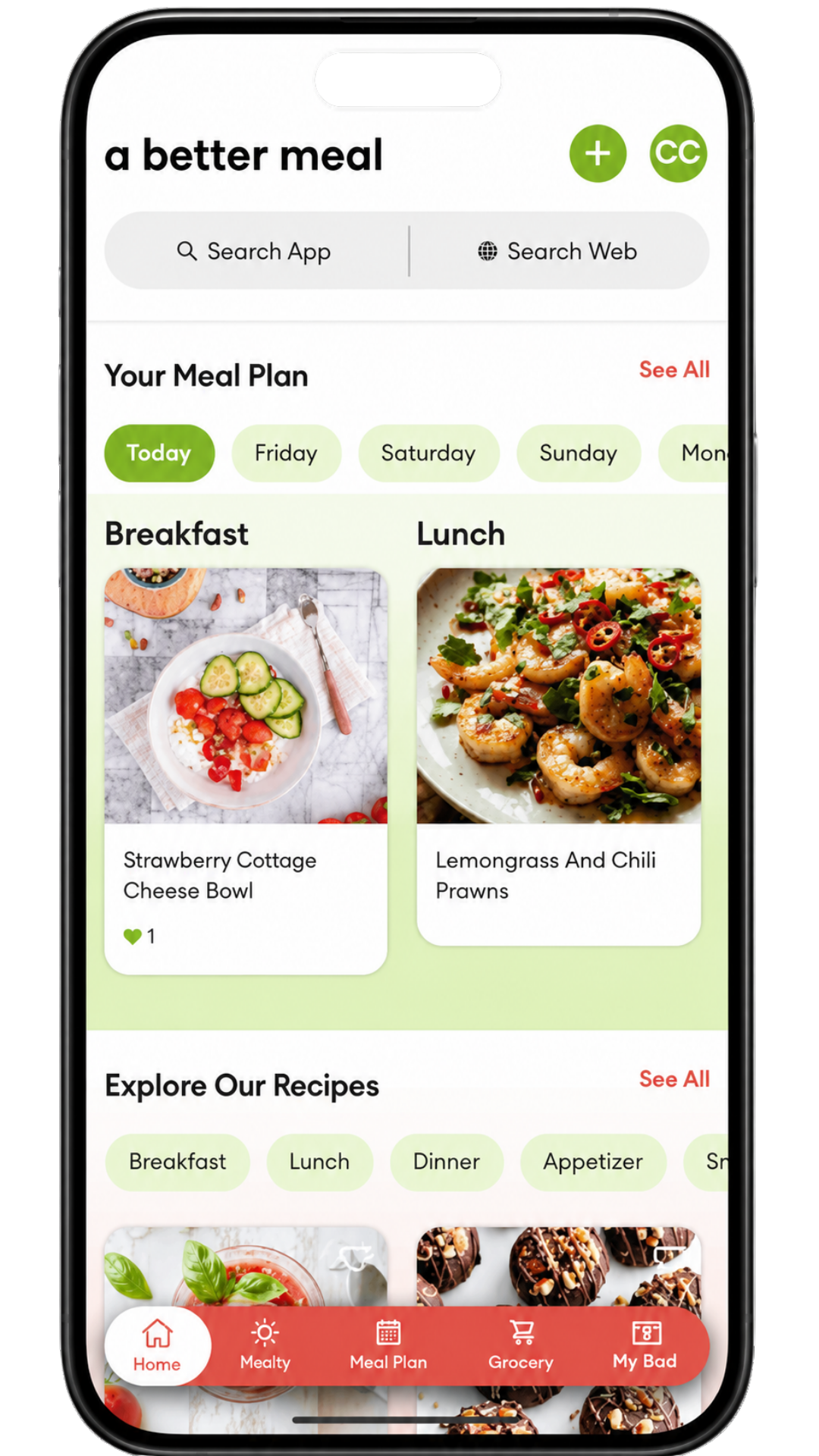
A Better Meal builds the grocery list out of the week’s plan in one action, not by asking anyone to type it in from memory. The list comes sorted by aisle, so a household of two or six is moving through the store once instead of doubling back for what got missed. Cross something off, add something extra, swap an ingredient: none of that touches the plan underneath it, so editing the list on the way out the door doesn’t undo the week someone already decided.
The list can be shared with the people in your household. It isn’t a live feed. Nobody’s phone buzzes the instant another person edits it, because it doesn’t need to: everyone’s shopping from the same plan already, which was the thing actually missing on the fridge pad. When it’s time to shop, A Better Meal can guide you through shopping online by opening a retailer search experience item by item. You still choose the products and check out yourself, and it works with close to 50 grocery and delivery services already on the roster.
The list didn’t need to be watched closely in the first place. It was built from a plan both people already agreed to, not from whichever person happened to notice the fridge was empty first. That’s a smaller promise than live sync. It’s also the one that actually holds up on a Wednesday.
Shared grocery list app: questions households ask
Does a shared grocery list app update in real time?
Not this one, and that’s on purpose. The list can be shared with people in your household, but nothing pings the instant someone adds an item; there’s no live, real-time sync. What both people get instead is the same list, built from the same plan, so there’s a lot less that needs to update in the moment to begin with.
What happens if we both add the same thing to the list?
Nothing breaks. Editing the list doesn’t change the plan underneath it, so one person crossing something off, or adding something extra, doesn’t undo what the other person built. And because the list started as one plan instead of two separate memories, there’s a lot less chance of the same item landing on it twice. If it does happen anyway, it’s a five-second fix at the store, not a reason to distrust the list.
Is a shared grocery list app worth it for a two-person household, not just a big family?
Yes, arguably more so. A big household usually has someone whose informal job is remembering groceries: an oldest kid, a grandparent, whoever’s been doing it longest. A two-person household often has nobody assigned to it at all, which is exactly how the list ends up on whichever phone happened to be open first. A list built from a shared plan works the same way whether it’s feeding two people or six, because the plan is doing the deciding either way.
Do I still need to check the list constantly for it to work?
No, and that’s the point of building it from a plan instead of a live feed. Open it when you’re ready to shop, not every hour to make sure nothing changed underneath you.
The plan a family will actually follow, not the list either person has to chase
A shared grocery list app that leans on live sync is solving for the wrong kind of shared. Watching the same screen change isn’t the same as not having to think about groceries alone. The list that actually works for a household is the one built from a plan everyone’s already shopping against, so the deciding happened once, before anyone picked up their phone at the store, and neither person is stuck being the one who has to remember everything for both of them.
That’s the version worth building toward: not a faster ping, but fewer things either person has to hold in their head. A family doesn’t need to be told to communicate better about groceries. It needs one fewer thing to communicate about in the first place.
Open the app. The plan’s already there.
Get your grocery list, sorted by aisle ?