
A Walmart pickup order does exactly what it promises. Build the cart online, pick a time, and someone else pulls each item off the shelf while you do something else entirely. Drive up, pop the trunk, and the bags land inside without a checkout line in sight. The actual shopping, the part that used to eat forty minutes out of a weeknight, just doesn’t happen anymore.
A Walmart pickup order and a Walmart meal planner do two different jobs, though. One fills a cart. The other decides the week. Most people only ever build the first one, and the deciding happens somewhere else, usually nowhere in particular. That’s not a knock on pickup. The order is genuinely reliable. It’s just reliable at the wrong job.
That reliability is real, and worth naming plainly. No wandering the aisles hunting for the right brand of tortillas, no wrestling a cart with a mind of its own, no standing in a line that’s somehow always the slow one. Walmart runs more than 10,900 stores and ecommerce sites across 19 countries, and something like 280 million customers show up each week, and pickup like that is close to the default for a lot of households now, not the rare convenience it used to be. None of that scale is the part that’s missing.
Why a Walmart pickup order still leaves Thursday undecided
Pickup is only as good as the week behind it, and most weeks get built from memory instead of a decision. What shows up in the order is whatever’s easiest to picture standing in the kitchen: the four things you can name without thinking, plus a hopeful extra or two that looked good in the app. By Wednesday, the reliable four have covered three dinners. The hopeful extras have covered none.
That pattern has very little to do with Walmart specifically, or even with pickup. It’s what happens whenever the deciding gets skipped and the ordering doesn’t. An order built from memory reaches for whatever’s easy to picture, which is almost always whatever got bought last time, because last time is the only data anyone actually has standing at a screen with fifteen minutes to spare and a cursor blinking in an empty cart.
Someone’s already asked twice what’s actually happening for dinner, and the honest answer sitting on the counter is frozen corn, a block of cheddar, and a can of black beans with nothing decided to put them in yet.
None of that is the order’s fault. It packed exactly what it was told to pack. The order was reliable. The week wasn’t, and pickup has no way of telling the difference. Pickup can ask what you want in the cart. It can’t ask what the household is actually eating this week, because that was never a question a shopping list was built to answer.
That distinction sounds small until Wednesday actually arrives. A pickup order that’s technically full can still leave a household with nothing that adds up to dinner, and there’s no line item on the receipt that flags it. The corn’s there. The cheddar’s there. What’s missing is the decision that would have turned them into three specific meals instead of a pile of ingredients waiting for someone to notice them.
By seven on a Wednesday, the cheddar and the flour tortillas are already most of the way to dinner, and the black beans are the only thing standing between that and a drive-through. A Better Meal starts earlier than that, back at the point where the deciding is still open.
The same four things, every week
Frozen corn, cheddar, black beans, flour tortillas: the order comes home with the same four almost every week, because they’re the four nobody has to think about. They cover a burrito bowl on a bad night and a quesadilla on a worse one, and there’s real relief in having something that dependable sitting in the cart. Nobody has to stop and wonder whether the household will eat cheddar. That question got answered a long time ago, and it stays answered.
The avocados that looked good in the app are a different story. They’re compost by the time anyone remembers buying them, and the cilantro’s gone slick in the drawer behind them. The order has plenty of good intentions sitting in it. What’s missing is a place for them to land. They get bought again the following week anyway, because they still look good in the app, and hope turns out to be a renewable resource even when the follow-through never quite shows up.
The four staples are doing exactly what a household needs them to do. The problem is everything past those four, still getting decided by whoever’s standing in front of the fridge at the worst possible moment, and pickup was never built to help with that part.
What a Walmart meal planner adds that pickup alone can’t
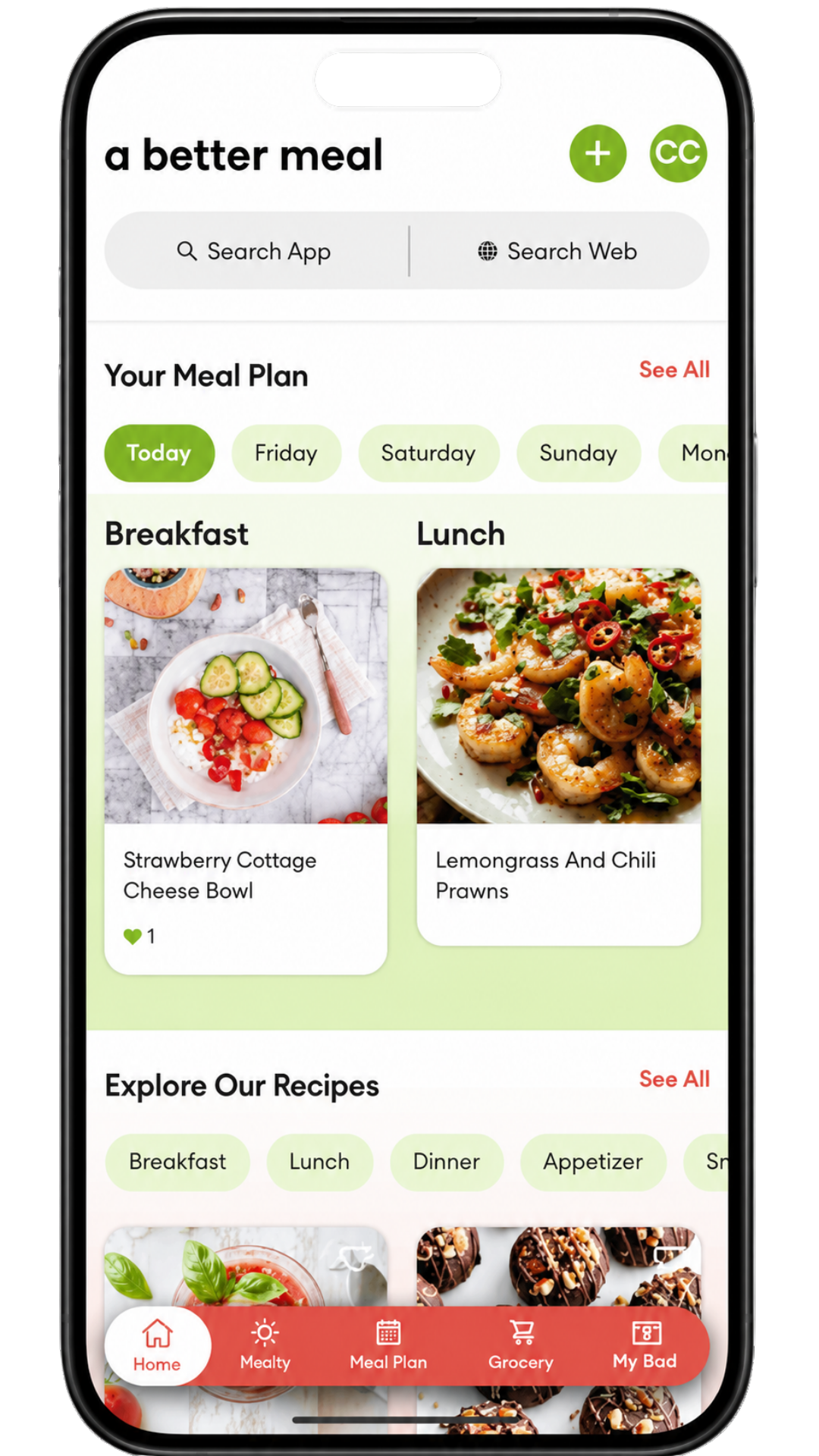
A Walmart meal planner does the thing a pickup order was never built to do: it decides what the week is eating before anyone has to stand in front of an open fridge and guess. You tell it your goals, dietary preferences, allergies, foods to avoid, and what looks good. From that, A Better Meal builds a dinner plan instead of asking you to start from a blank page. That plan is where the deciding actually happens, and it happens once, well before pickup ever enters the picture.
It can also draw from your preferences, saved recipes, and past interactions, so the plan is not just the same hand-built rotation every week. A Walmart pickup order asks what you want right now. A Walmart meal planner asks what the household needs this week, and answers before the fridge gets opened. Frozen corn and black beans can still show up, because they earned their spot, but they show up as part of a decided dinner instead of a placeholder for one.
When a week feels like too much even with the plan already built, there are plan actions for that too: reducing time, simplifying instructions, or choosing meals with fewer ingredients. Pickup was never built to help with any of that. It was built to help with the trip, and it’s good at the trip. A Walmart meal planner is built to help with everything that happens before the trip, which turns out to be most of the actual work.
The grocery list falls out of that plan in one action, because a grocery list worth trusting starts as the same decision as the meal plan itself, not a separate errand built from memory later. A smart-sounding list is still just a list. Even a smart shopping list still needs a decision behind it, and that decision is the part pickup can’t supply on its own.
Walmart is one of close to 50 grocery and delivery services on A Better Meal’s roster, so the Walmart grocery list gets the same treatment as any other store on it. When the list is ready, A Better Meal can guide you through shopping online by opening a retailer search experience item by item. You still choose the products and check out yourself, whether the order comes by walmart grocery pickup or by delivery to the door. That matters for the same reason pickup itself caught on in the first place: nobody wants a new habit to learn. The plan works with the store already in the routine, instead of asking for a different one.
The grocery list that fills the order instead of memory
That’s the whole difference a Walmart meal planner makes: pickup still does the errand, but the plan already did the deciding. The list comes out sorted by aisle, or, if that’s more useful, displayed By Recipe so you can see which dinner each item belongs to. Edits don’t touch the plan underneath it. Change the list and the week holds. You can cross something off because it already turned up somewhere else, or add something because a recipe changed, and the rest of the week stays exactly where it was.
You can send a single recipe to the list, several recipes at once, or the next three or six days, depending on how far ahead you’re willing to think on a given Sunday. None of that requires rebuilding the week to use. Ask for three days when three days is as far as anyone can think, or six when the week feels more settled than usual. It can’t see your cupboard, and it isn’t trying to. What it can do is start from a week that’s already decided, so the order gets filled from that instead of from whatever’s easiest to remember standing in the kitchen.
None of this makes A Better Meal a price optimizer, and it shouldn’t try to be one. Its budget value is indirect: a settled plan reduces defensive shopping, duplicate purchases, and takeout drift, in a way a budget plan that goes stale by the second week never quite manages. The corn, the cheddar, the beans, and the tortillas were never the expensive part of any order. The extras bought on hope and abandoned by Thursday usually were, and a plan is what keeps that from happening without anyone tracking a single price.
When more than one person in the house shops, that matters even more. Two people shopping against the same week without talking about it usually means overlap in the cart and gaps at dinner. A shared grocery list only holds together if it starts from one plan, instead of two people half-remembering the same week differently.
Walmart describes its own purpose as saving people money so they can live better, and calls itself a people-led, tech-powered omnichannel retailer. That’s a reasonable thing for a store to promise. It still isn’t a plan, and it was never going to be one.
A plan you can trust by Wednesday
A plan doesn’t have to be perfect to be worth trusting. It has to still be there when you get to it. The dinner plan you looked at on Sunday is the same one waiting on Wednesday, unless you’re the one who changed it, and changing it is still yours to do, any time you want. Nobody has to re-decide the week from scratch just because Tuesday ran long.
That’s the part a Walmart pickup order can’t offer on its own, no matter how many stores back it up or how many customers walk through them every week. Reliability at the register is one kind of trust. Knowing what Wednesday is eating before Wednesday arrives is a different kind, and it’s the kind that actually gets dinner on the table without anyone standing at the fridge negotiating with themselves.
That’s worth sitting with for a second, because it’s easy to read reliability as a synonym for a big store with a lot of trucks. Walmart’s version is real: thousands of locations, millions of people through the doors every week, a promise about saving people money built into how the company describes itself. None of that replaces a plan. A store that size is a genuinely reliable way to execute one, once one exists.
The plan is the product here, not the errand that fills it. See what A Better Meal actually does once the deciding’s handled, and the pickup order becomes what it was always supposed to be: the easy part, the last small errand after the one that actually mattered.
The plan you keep meaning to make? It’s already in the app.
Fill the order from a week that’s already decided.