
A grocery list that never has to be rebuilt is the relief in question here. A Whole Foods meal plan that actually holds looks almost unremarkable from the outside: the list exists before anyone opens the app, sorted by aisle, waiting on a trip that’s already decided. What most households build instead is a new list every week, assembled from whatever survived Saturday night’s half-decided thinking, which turns out to be a much harder job than the shopping itself.
A Better Meal is the reason that first version of the week exists at all. The plan gets decided once, and the grocery list falls out of it in a single action instead of getting typed in from a blank screen every Sunday morning. Whatever gets crossed off that list afterward doesn’t touch the plan underneath it, so changing an item is just changing an item, nothing more.
Most grocery stores let a shopper improvise. Whole Foods makes that harder, on purpose, in a way that’s easy to miss until the cart is half full and nothing on the shelf quite matches the vague plan somebody had in their head walking in.
Type “whole foods meal planning” into a search bar and most of what comes back assumes the planning is the project: a template to fill in, a week built square by square, more work before the trip instead of less. The actual complaint underneath that search is simpler than planning as a hobby: wanting the deciding already done by the time the list needs to exist.
That’s the part most advice about a meal plan grocery list skips over entirely. The list gets treated as the hard part, the thing to fix with a better app or a better folder of recipes, when the actual work happened earlier, in a decision that either got made or didn’t. A list built without that decision underneath it is just a longer errand with neater handwriting.
Why a Whole Foods meal plan takes more deciding than most grocery runs
Whole Foods bans more than 300 ingredients from everything it sells, including hydrogenated fats, high-fructose corn syrup, and sweeteners like aspartame, sucralose and saccharin. The store also holds itself to more than 100 animal welfare standards and calls itself the first and only certified organic national grocer. Genuinely useful things for a shopper to lean on. Also a real constraint: a smaller shelf than most stores carry, filtered hard before anything reaches it, which means the easy fallback, the thing that’s always there in a bigger store, isn’t always there.
A bag of swiss chard, picked up because the case made it look worth cooking, goes slick on the second shelf of the fridge by Thursday, still waiting on whichever dinner it was supposed to join, while somebody in the kitchen keeps asking what it was even for.
Search “Whole Foods shopping list” or “Whole Foods delivery” and most of what comes back is about the store itself: which aisle has what, which label passes the standards, how the store brand compares to the name brand next to it. None of that answers the question that actually decides whether the trip works, which is what the week is going to be before anyone gets there.
The standards page reads like the actual reason a shelf that looks smaller than a supercenter’s still earns trust: what’s missing from it was taken off on purpose, not left off by accident.
Two different people end up typing “whole foods meal plan” into a search bar, and the split matters more than either result page admits. One is looking for a template, something to fill in a blank week with. The other already knows dinner should just show up decided, and wants to know whether shopping at a store with real standards makes that harder to get. It doesn’t, once the week itself stops being the open question.
The store is built for a shopper who already knows the week. Guessing is where it gets expensive, in dollars and in wasted trips back for the one thing that turns out to be missing. A shopper who’s decided the week in advance walks past most of that decision-making without needing it. A shopper who hasn’t ends up standing in front of a label for ten minutes over a choice that was never really about the label.
What happens when the week isn’t decided before the cart is
Walk into Whole Foods without a decided week and the aisles start making the decisions instead. A bag of blood oranges looks good in the case on a Wednesday, and goes home without a dinner attached to it. By 7:10 that same week, a wedge of goat cheese is still sitting in its wrapper on the counter, a decision nobody quite got around to making. Four good ideas in a cart don’t add up to one finished meal. They add up to a fridge with four separate things in it, and nothing that was ever actually going to become dinner.
None of that is really about willpower, or about how good someone is at planning. A store built around real standards is, structurally, a store that assumes the shopper already knows what they’re doing. That’s a fair assumption for someone who decided the week on Sunday. It’s a rough one for someone deciding it in the aisle, item by item, under a little bit of time pressure.
Search for a weekly grocery list app and most of what comes back is exactly that: a list. The week that decides what belongs on it is the part that’s missing. A meal plan grocery list is downstream of a decision, not a replacement for one, and handed a list with nothing behind it, most people end up rebuilding the missing decision anyway, standing up, cart handle in one hand.
The cost of that rebuild shows up in dollars sometimes, but mostly it shows up in the trip that has to happen twice: once for dinner, and once for the ingredient that only turns out to be missing after the stove is already on.
The list gets rebuilt because the week gets decided from scratch
The forty-odd minutes it takes to build a grocery list from nothing is a scheduling problem wearing a grocery list’s clothes. The list gets rebuilt because the week gets decided from scratch, every single time, not because grocery lists are naturally hard to write.
Fixing the list without ever fixing the deciding just moves the same forty minutes to next Sunday. Farro that’s been sitting in the pantry since a recipe called for it three trips ago hasn’t made it into a single dinner since, and nobody’s thrown it out, because throwing it out would mean admitting the plan for that week never really existed.
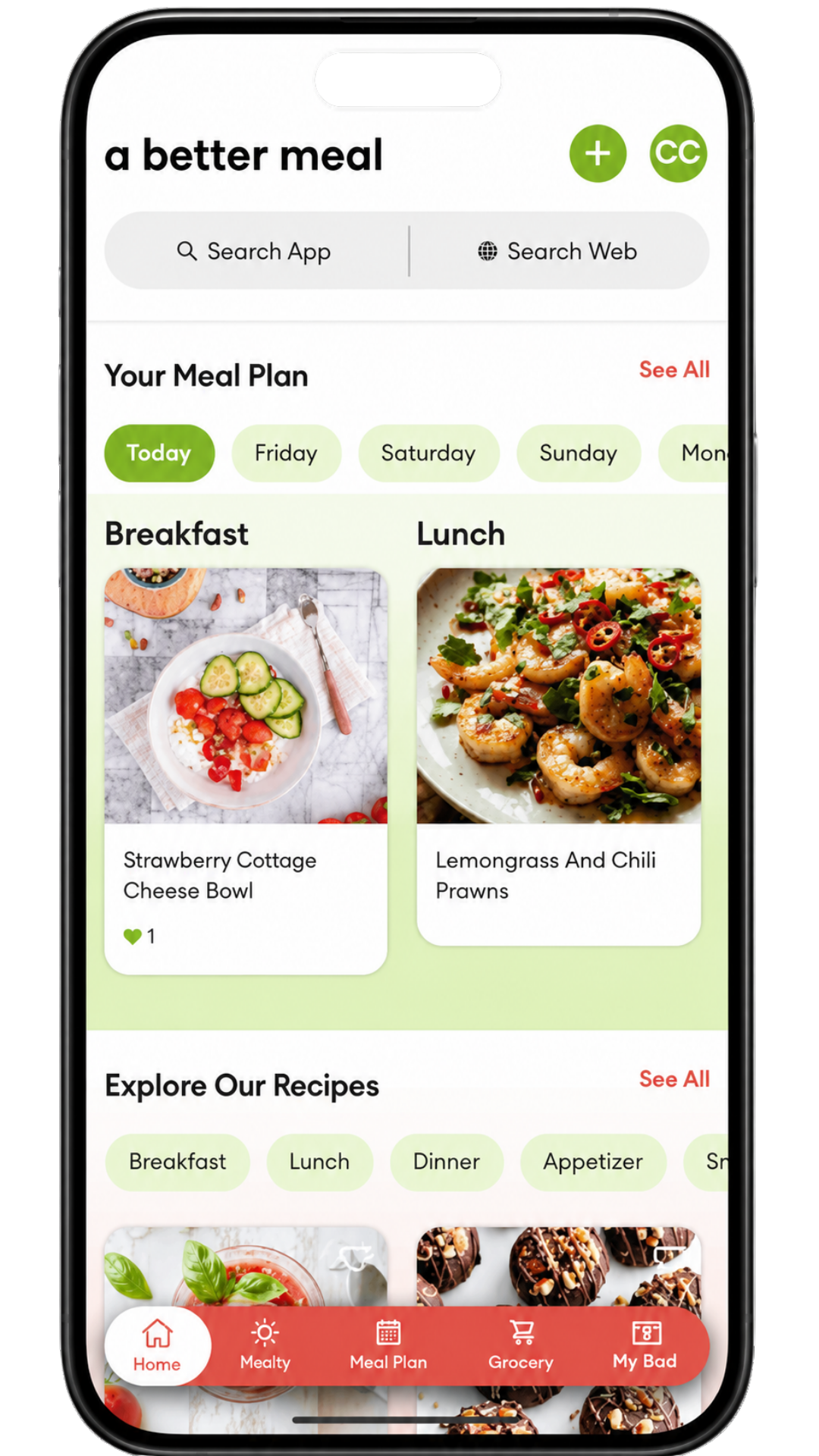
A Better Meal’s version of the week starts from what’s actually true about the household: the goals, the things somebody won’t eat, the stuff that’s already been ruled out. From that, it builds a dinner plan instead of leaving the deciding for whenever the cart is already half full. Here’s what that actually looks like once it’s built. The meal plan’s grocery list is the easy part after that. It’s auto-generated from the plan in one action, and changing an item on it afterward doesn’t touch the plan it came from.
Some weeks don’t hold their shape, and the plan has room for that too. There’s a version of most weeks where fewer ingredients, or less time at the stove, turns out to be the actual need, and that’s a choice made inside the plan rather than a reason to throw it out and start the whole week over from a blank page.
Recipes that already work for the household don’t have to get abandoned to make any of this happen, either. Bringing them in is part of the same plan, not a separate project, so a Whole Foods meal plan can still be built around dinners that were already trusted before anyone opened the app.
A Whole Foods grocery list that starts from a decided week
Whole Foods is one name on a longer list. A Better Meal’s roster runs to close to 50 grocery and delivery services, Instacart and Amazon Fresh and Walmart and Kroger and Aldi and Target among them, and Whole Foods is on it too. The same plan-first logic holds wherever the list lands; an Instacart grocery list still starts with the plan just as much as a Whole Foods one does.
The list itself comes in two shapes once the plan exists: sorted by aisle for the trip, or By Recipe, which keeps every ingredient tied to the dinner it’s actually going toward. A grocery list by aisle fixes the trip, and the plan underneath it is what fixes the week. By Recipe matters more than it sounds like it should: it’s the view that keeps a Wednesday-night swap from turning into a guessing game about which item on the list belonged to which dinner in the first place.
Sending items to the list doesn’t take long either, and the modes are flexible enough to match how differently people actually plan. A single recipe, added on a whim, the night before. A handful of recipes, added at once after batch-deciding the shape of the week. The next three days pushed over ahead of a short trip, or the next six ahead of a bigger one. Whichever mode gets used, the list behind it is already sorted by aisle by the time it opens. The whole thing moves from meal plan to grocery cart in minutes, not the better part of an evening.
On the shopping side, A Better Meal can guide you through shopping online by opening a retailer search experience item by item. You still choose the products and check out yourself. That’s true whether the trip is Whole Foods delivery or the in-person version, phone in hand, list already sorted by aisle.
There’s a limit worth naming plainly. A Better Meal can’t see your cupboard, and it doesn’t subtract what’s already on the shelf at home from the list. What it does instead is start from a week that’s actually been decided, so the list reflects what that week needs rather than a guess at what might already be sitting in the pantry. Most Whole Foods shopping lists get built the other way: item by item, from memory, under time pressure. The best grocery list app for a family starts with the week already decided, not with a blank list waiting to be filled.
One trip through Whole Foods covers the week
The EPA’s own food-waste guidance says almost exactly this: plan your meals for the week before you go shopping and buy only the things needed for those meals. That’s federal advice on cutting waste, not meal-planning-app marketing, and it happens to describe a Whole Foods meal plan that holds.
A single pass through the store matters more at Whole Foods than it does somewhere generic, precisely because of the constraint the standards create. A smaller, filtered shelf rewards someone who isn’t backtracking through it twice: once for the ingredient that got forgotten, and once for the substitute they’re settling for instead because the first thing wasn’t on the shelf to begin with. Backtracking is expensive everywhere, but it’s a specific kind of expensive at a store where the substitute has to clear the same 300-ingredient standard the original did, which rules out most of the quick swaps a generic store would let a shopper reach for instead.
Whole Foods is one of close to 50 grocery and delivery services on A Better Meal’s roster. The list sorts by aisle, so the trip moves in one direction instead of doubling back for the one thing that got missed. One trip, decided once, covers the week that’s already been planned instead of half of one that’s still getting figured out in the aisle.
Whatever’s on the list afterward is still easy to change. Add something, drop something, and the plan underneath doesn’t have to be rebuilt to absorb it. Whole Foods meal planning stops being a Sunday project and starts being one decision that keeps paying off through Thursday.
That’s the whole shift a Whole Foods meal plan is actually asking for: one less week spent deciding it from nothing, with the list simply following behind, already sorted, already built, by the time anyone needs it.
Dinner, handled. Try a week with A Better Meal.
Get your grocery list, sorted by aisle.